I want to learn...
Author:

Barney Meekin
If you’re preparing to take the TOEFL to study in an English-speaking country, this article will explain how to prepare for TOEFL exam with effective study tips.
Achieving a high score on the TOEFL shows you have what it takes to understand lectures, write essays, read academic texts and participate in class discussions. It is one of the best ways to show your academic English skills on university applications.
In this article, you’ll learn all about the TOEFL and get four proven tips for TOEFL preparation.
The benefits of using Busuu to prepare for the TOEFL test
Self-study from beginning to advanced level
Busuu’s English courses start at A1 (beginner) and go all the way up to C1 (advanced). So no matter where you are on your TOEFL journey, Busuu can help you reach the next level. Get the necessary vocab, grammar, listening and reading skills to make progress in English. Pass tests and get certificates along the way.
Academic English and exam prep courses
You’ve made progress in general English and now it’s time to master academic English and test taking. These are different skills. That’s why Busuu Premium includes an English for Academic Studies and an English Exam Success course. Everything you need for your TOEFL preparation, at your fingertips.
High-level reading and listening practice
The TOEFL has some pretty difficult reading and listening sections. To make sure you’re ready, check out Busuu Premium’s The Economist course and the World in English course with videos from The New York Times. You get access to high-level reading and listening materials – an excellent resource for TOEFL practice.
What is the TOEFL test?
TOEFL stands for Test of English as a Foreign Language. It’s a popular academic English proficiency test for international students. Take the TOEFL, and you’ll get a certificate proving your English proficiency, which you can then share with university admissions. The most popular version of the TOEFL is the TOEFL iBT (internet-based test). So this is the one we’ll talk about in this article.
Who needs to take the TOEFL?
A TOEFL certificate is most useful for people who want to enter a university in the USA. It’s also widely accepted at universities around the world, along with other English proficiency tests, like the IELTS.
TOEFL vs IELTS
TOEFL’s main competitor is the International English Language Testing System (IELTS). Both these tests assess your academic English skills, and both have online versions you can take on your computer. But there are some differences.
First, the TOEFL includes multiple-choice questions in the listening and reading sections. This means the answers are already on the page. The IELTS includes multiple choice and short answer questions. So you’ll need to write the answers. Next, you'll record yourself on a computer when you do the TOEFL speaking test. On the IELTS test, you’ll talk with a person.
And here’s the big difference. TOEFL is the most commonly accepted certification for universities within the USA. IELTS is more common in Australia, Canada, the UK and New Zealand.
Which test you decide to take depends on your target university. So before you decide, contact admissions and find out which certificates they accept.
What are other alternatives to the TOEFL test?
TOEFL and IELTS are the two main academic English exams. But there are others, too. The Pearson Test of English (PTE) Academic English is another widely accepted certification.
The advice from above still stands. Check admission requirements to see which test is the best one for you to take.
Four tips for smashing the TOEFL test
TOEFL preparation isn’t easy. If you’ve never taken the test before, it’s especially difficult. But don’t worry. We’re here to help. Here are four tips that will help you prepare for the TOEFL iBT and give you the best chance at getting your desired results.
1) Understand the TOEFL format
Let’s break down what the TOEFL looks like. The TOEFL iBT has four sections and takes around two hours to complete. Here are the sections in order of the test:
Reading
The reading section consists of two 700-word reading passages with ten questions each. The reading passages come from university-level textbooks and cover a variety of topics.
The reading section should take around 35 minutes to complete.
Listening
In this section, you’ll listen to three lectures of around three to five minutes and two conversations of around three minutes each. The lecture passages have six questions each. And the conversations have five questions each.
The language used in the listening passages is common university language, and you may hear accents from various English-speaking countries. The test should take around 35 minutes.
Effective note-taking is essential if you want a good score on the listening section.
Speaking
There are four questions in the speaking section. The first one is called the Independent Speaking Task. You need to talk about your own ideas, experiences and opinions for this question.
The other three questions are called Integrated Speaking Tasks. You need to read and (or) listen to a passage before talking about it.
For each question, you have up to 30 seconds to prepare before talking, and you’re expected to talk for 45 or 60 seconds. The total time of the speaking test is around 15 minutes.
TOEFL uses a combination of AI and human raters to score your speaking test. You can learn more about how it judges your speaking in the TOEFL iBT Speaking Scoring Guides.
Writing
The final section on test day is writing. There are two tasks – an ‘Integrated Writing Task’ and a ‘Writing for an Academic Discussion Task.’
For the Integrated Writing Task, you listen to a short lecture and read a short passage. Then, you need to write a response to what you read and listened to. You have 20 minutes to do this.
For the Writing for an Academic Discussion Task, you have to write your opinion in an online classroom discussion. You have 10 minutes to do this.
TOEFL uses a combination of AI and human raters to score your writing test. You can learn more about how it judges your writing in the TOEFL iBT Writing Scoring Guides.
Scoring
You get a score of 0-30 points for each of the four sections. Then all scores are added together to give you a total score. When you get your results, you’ll get a detailed report. This report includes your skill level for each section, plus feedback on which question types you performed well on and which you struggled with.
You’ll also get detailed feedback about your writing and speaking performance, with some high-scoring examples to compare your answers to. This will help you improve your test performance if you ever need to take it again.
2) Learn the types of questions
When preparing for the TOEFL test, your study sessions need to be specific and intentional. That means addressing your strengths and weaknesses in relation to the test and the types of questions that appear on it. It’s a very different approach than if you’re just learning English as a hobby.
Each section on the TOEFL iBT consists of different types of questions. You need to practice those specific questions. Just reading without doing some of the questions from the test, for example, won’t give you the results you want.
Your first stop before starting your test prep is finding out what questions appear in each section. We talked about the questions for the speaking and writing questions above. The reading and listening sections have several unique questions, too. There are too many to go over all of them in this article, but luckily, the official site has lots of great information to help you. Read about the listening questions and reading questions before doing anything else.
3) Review past tests
The next thing you should do is take a TOEFL practice test. This might sound like a strange thing to do before you start studying, but trust me – this will help. Get one of the previous tests and give it your best shot. The official TOEFL site has a free practice test that’s perfect for this.
The test might be difficult, but your results will be the foundation of your test prep. Think of this initial practice test like a trip to the doctor. You’re testing what’s healthy (strengths) and what’s not (weaknesses). Your diagnosis will tell you exactly what you need to study to achieve your goals.
Look at which sections you struggled with the most. Then, look at the question types within each section. Were any question types difficult for you? You can use this information to design your study plan.
4) Work on your weaknesses (but don’t neglect your strengths)
You’ve done your TOEFL practice test, seen your results, and know your strengths and weaknesses. Now, it’s time to fill any gaps in your skills.
Prioritize sections and question types that are difficult for you. Spend most of your TOEFL preparation time working on them. But don’t forget the stuff you’re good at. You still need to practice all four skills and all question types, but most of your time should be spent on your weaknesses.
It’s not enough to just practice the skill when it comes to difficult question types. You also need to learn the best strategy for that question type. Luckily, a quick Google or YouTube search will give you tons of information to help you overcome any problems with question types.
Why Busuu is the best place to prepare for the TOEFL
Get feedback on your writing and speaking
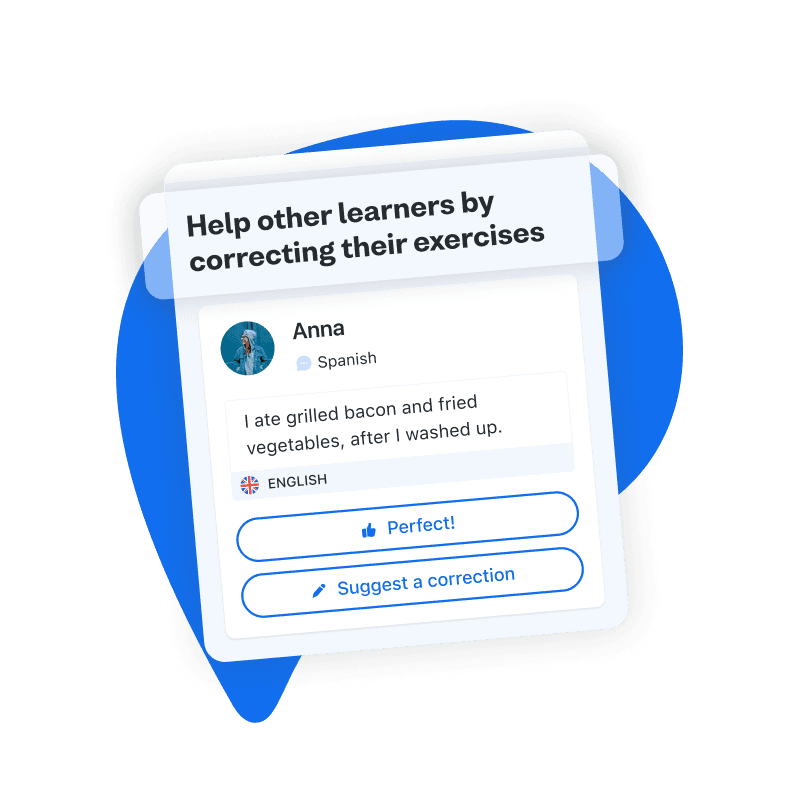
Busuu’s online community is full of millions of language learners (many of whom are native English speakers). Practice for the TOEFL test and share your writing and speaking. You’ll get feedback from the online community, helping you get ready for test day.
Easy-to-complete lessons
TOEFL practice doesn’t have to take forever. You don’t need huge textbooks and long lessons. With Busuu you improve your academic English skills with bite-sized videos and lessons – perfect for squeezing into your busy day.

Expert-designed listening and reading courses
Practice reading and listening with resources from the best. Busuu has teamed up with The Economist and The New York Times to give you access to high-level and high-quality English content. Use these to practice for the tricky TOEFL reading and listening sections.
Ace TOEFL with these tips
Getting a good score on the TOEFL is a huge challenge. But if you follow the tips in this article, it’s one that you can overcome. When preparing for the TOEFL, your study routine needs to be specific to the test. That means taking some time to understand the test and its format beforehand. Take a TOEFL practice test to assess your level and then use this information to prioritize your study time.
Master English with Busuu
With Busuu, you can focus on the English skills you need the most. Preparing to study abroad? Take our English for Academic Studies course. Getting ready for a trip? Try our English for Travel course. Using English for work? Our English for Business course might be just the thing. Learn the English skills you need, at a pace that fits your lifestyle.
AUTHOR
Barney Meekin
Newlanguages