Imagine you’re on holiday: ordering a drink, asking for directions, or you’re taking a lesson to brush up on your language skills. You keep making that same mistake. We’ve all been there. It’s frustrating and can make you feel like the only learner not making fast progress. But here’s the truth. You are. In fact, your errors prove it. Every single learner makes mistakes. And you shouldn’t sweat them, because they’re your progress coming to life.
It might sound like a contradiction, but we’ve got the stats to back it up, too. When researching our brand-new tool, Mistake Repair, we took a deep dive into the mistakes made by our English and Spanish learners across 18 countries. What we learned might just surprise you… A little spoiler: Over 12 months, Busuu Spanish and English learners made over 7000 mistakes. So, if you’re making them, you’re in good company.
So, let’s break down the myths and realities of making mistakes - and why they’re the key to unlocking fluency.
The research lowdown
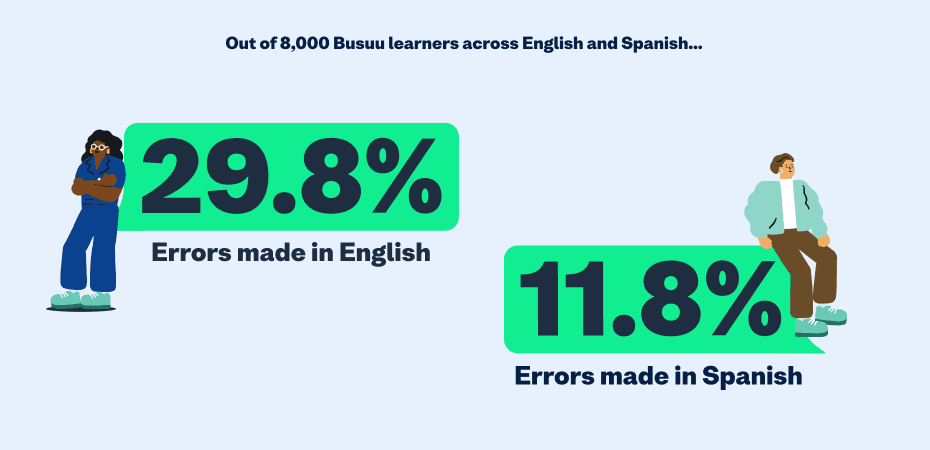
We analysed the mistakes made by 8,000 Busuu learners studying either English or Spanish, two of the most widely spoken languages in the world.
We were surprised by what we found…
According to the research, English learners made a total of 29.8% errors, compared to 11.8% made in Spanish.
But let’s break that down a bit further. Grammar is the clear trouble spot for both languages, making up 45% of all errors.
Learners studying English struggled mainly with spelling, while tenses, grammar and ‘false friends’ caught Spanish learners out the most.
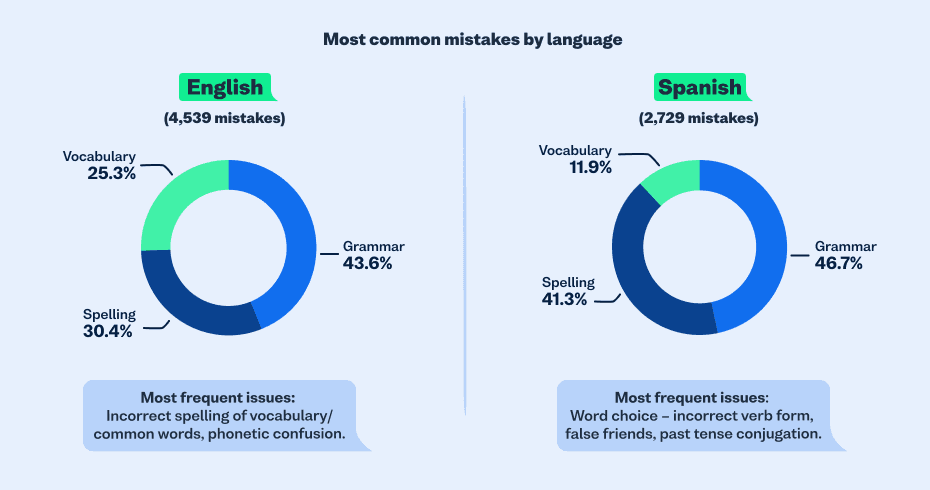
Every language learner, across every level, makes mistakes. Mistakes aren’t random; they’re a reflection of how we learn.
The myth: “Mistakes are holding me back”
The reality: They’re the key to unlocking progress.
We know it sounds too good to be true. But the main reason we created Mistake Repair is to provide a space where your recurring errors can become your most valuable lessons.
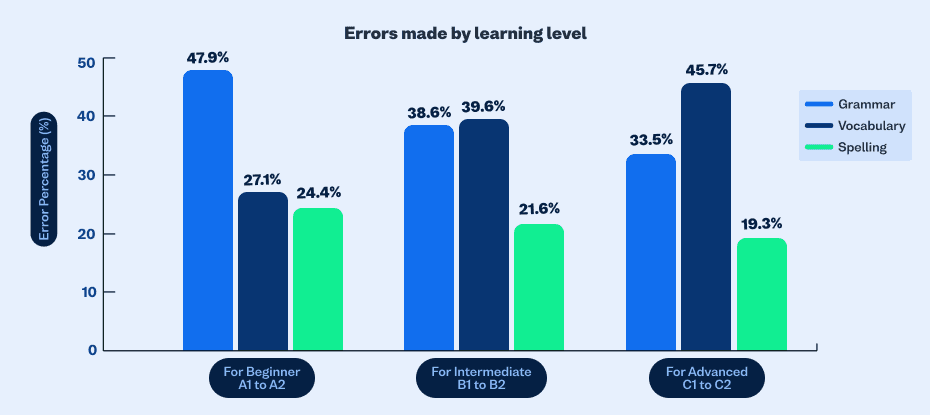
For beginners at A1 to A2 level, 47.9% of mistakes made were grammar-related.
For more advanced learners, 45.7% of errors are tied to vocabulary.
Beginners had the most trouble with basic sentence structure; more advanced-level mistakes were more complex.
Making mistakes might get frustrating when you’re in the thick of learning, but your weak spots matter more than you think.
They’re actually your biggest indication of progress - your learning superpower. Without them, our brains wouldn’t be nearly as effective in remembering the right words to use.
It’s just one of the reasons we designed Mistake Repair, which takes your top weak spot at that time in your learning journey and turns it into exercises built just for you. It helps you learn by practising your mistakes, so you can stop making them again in the future.
Learning tip:
Review your mistakes regularly! The topics might be more difficult, but if you make a habit of dipping into Mistake Repair every other learning session or so, you will see your confidence grow. The best way to repair mistakes and build long-term memory is to space out these review sessions. If you want more in-depth practice of each focus area in Mistakes Repair, we recommend giving the matching Grammar Review topic a go. Practising the two together will help your all-round knowledge!
The myth: “My chosen language shouldn’t be this tricky”
The reality: Errors? They’re universal. It’s not you, it’s the language.
It doesn’t matter where you’re from. What matters most is the language you’ve chosen, because the learner experience is universal.
We analysed learners from 18 different countries, studying either English or Spanish, and mistakes were made across each region, suggesting it’s the difficulty levels of the languages themselves that matter, not where you’re learning from.
English, in particular, likes to catch learners out. Like how ‘though’ and ‘through’ might be spelt alike, but are pronounced entirely differently, and the ‘w’ in ‘wrong’ might as well not be there at all. Every language has its complexities, so getting it wrong is just part of the process.
It’s also why we’re so proud of our global, online Community, where you can exchange corrections with other learners. By giving and receiving feedback, you’re not only helping and learning, but you’re seeing that other learners make mistakes too. And you're all in it together.
So, next time you’re having a conversation in English or Spanish, feel confident knowing that every other language learner has been there, and the Busuu Community is there to support your progress.
Learning tip:
Just as you make a habit of your learning schedule, in each session, you should include time to submit and correct your fellow learners’ answers in the Busuu Community. Your ability to form sentences in your new language will show you just how much progress you’re making, and keep you motivated along the way. Who knows, you might meet some study buddies to keep you accountable!
The myth: “I must be making more errors than other advancing learners”
The reality: Your errors grow with you - they’re a sign you’re getting better!
We analysed the mistakes of learners across all levels, from A1 to C2. You might think these mistakes slowed down as learners advanced, but the research reveals the opposite.
The phrase ‘practice makes perfect’ might give you classroom flashbacks, but the data proves how true that really is (and that your teacher was right). As our learners advanced through the levels, their mistakes became more nuanced. That’s because they’re making progress.
Across both English and Spanish, while grammar errors went down from 47.9% to 33.5%, vocabulary mistakes rose from 27.1% to 45.7%.
If you’re reading these stats and thinking, ‘I’ll make mistakes forever’, don’t panic. You’re building your foundation when you begin, so you’ll naturally make more complex errors as your knowledge improves.
Our mistakes evolve with us and mirror where our skills are growing. Languages are complicated, but your learning journey is an evolution. Lean into your mistakes, they’re just a part of learning and correcting them is key to your learning fulfilment and understanding.
Learning tip:
It’s true that as you progress, your mistake types might change - but this is a reflection of the language you’re exposed to when you reach higher levels. No matter your level, try to build conversational practice into your routine. AI Conversations gives you the chance to use language more freely, and you can try out your new C1-level vocabulary and build your confidence in making the language your own.
Conclusion: Celebrate your progress-boosting mistakes!
Whether you’re just starting or you’re frustrated you’ve made that one C1 error again, the research can’t be denied. Mistakes are natural and happen to everyone across the globe because although languages aren’t built the same, learners are.
Every error is a reminder you’re making progress, so next time you feel embarrassed, brush it aside and feel proud of how far you’ve come instead. Mistakes are milestones. They evolve as you progress, proving that every error is a step closer to fluency.
Learning English or Spanish? Try Mistake Repair for personalised exercises and instant feedback on your top error, helping you improve your language game with every lesson.
Newlanguages