I want to learn...
Author:

Emily Duncan
What you'll learn:
You’ll learn how verb forms show time—past, present, or future—so plans you share in a text message feel clear.
You’ll meet the 12 English forms, including simple, continuous, perfect, and perfect continuous, so a meeting recap makes sense.
You’ll see why the right verb form matters in speaking and writing, so listeners understand your timeline.
Using the right verb tenses is essential to communicating clearly in English, so this guide features all 12 English tenses with examples to make sure you can say exactly what you mean to say.
Past, present, future, ongoing?
Mastering English tenses is one of the most important skills to learn when studying the English language. Tenses are important in both speaking and writing because they help us clearly indicate the time at which something has happened.
So, without further ado, let’s learn English tenses.
Learn English grammar actively with Busuu

The English lessons you need
Jump into the right English lessons for you with a placement test and tailored courses like English for Exam Success and English Pronunciation.
Interactive exercises, powered by AI
Build confidence and strengthen your writing and speaking skills with unique AI exercises designed and tested by language learning experts.
Support from a community of learners
Make sure your English is on point with tips and tricks from fluent English speakers when you join Busuu’s supportive community of learners like you.Tenses in English
What is a tense? A tense is a form of a verb that indicates the time you are referring to. The tense of the verb tells us when an event or something existed or when a person did something. The three main verb tenses are past, present and future.
Tenses in English grammar with examples
Let’s look first at the three most basic verb tenses.
Simple past tense
The simple past tense is used to describe an activity, event or state of being that happened in the past. Sentences in simple past often include a time marker to indicate the specific time when the event or action took place.
Form: subject + past form of verb
In the examples below, notice how the underlined verbs are in their past form.
We
met
yesterday.He
bought
a new laptop last week.
Simple present tense
The simple present tense is another of the most basic tenses in English. We use it to talk about facts, habits and states or conditions that currently or always exist.
Form: subject + basic verb form (add “-s” if the subject is third person singular)
In the following examples, notice how the verbs end in “-s.” That’s because the subject refers to a third person.
She
lives
in Spain.Bob
drives
a taxi.
However, if the subject is I, you, we, they, or a plural noun, we don’t add “-s” to the verb, as in the examples below.
I
live
in Spain.We
drive
a taxi.
Simple future tense
Use the simple future tense to describe an event or action that has not yet happened and is expected to happen in the future.
Form: subject + shall or will + basic verb form
Notice how the following sentences have will or shall followed by another verb.
He
will be
here soon.We
shall meet
at lunchtime.
Once you have learned the three main types of English tenses, communicating in English will become easier. But to communicate more clearly and accurately, you’ll need to learn how to use other verb forms. This is sometimes called “verb conjugation.” For a complete guide on how to conjugate tenses, check out our guide on English conjugation
Why Busuu is the best place to learn English grammar
Award-winning language lessons, designed by experts
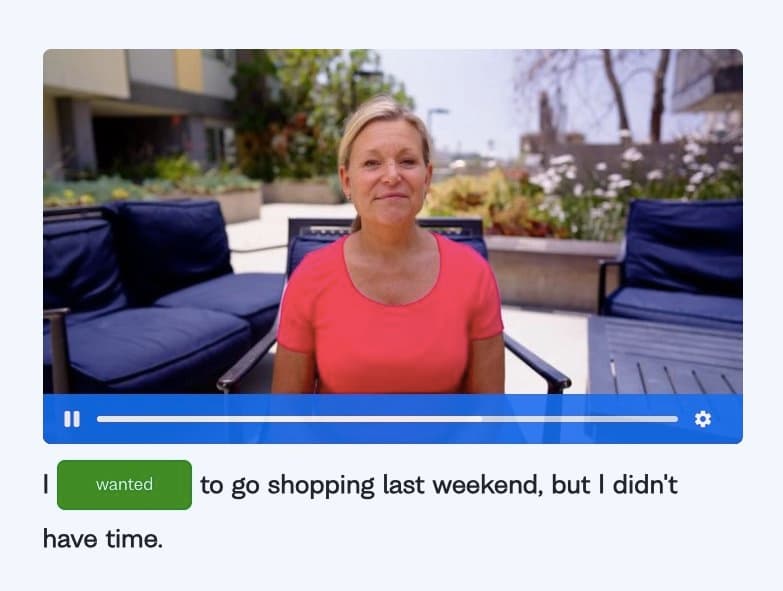
Whether you want to keep working on mastering English tenses or are ready to tackle other tricky English grammar, Busuu has the right lessons to get you where you want to go. Busuu’s bite-sized lessons are designed by language learning experts to make sure you learn as efficiently as possible and remember what you learn.
Comprehensive lessons, targeted practice
When you learn with Busuu, you can choose to take one of our Complete English courses (in UK or US English) or to focus on topics like English for Academic Study, Travel, or Essential Business Skills. Then you’ll use smart tools to practice the topics you find most challenging and data-backed spaced repetition to review what you’ve learned.
Designed to help you overcome common language learning problems
Many online language learners do great on short quizzes, but struggle when it comes to actually using their new language skills in real-life situations. That’s why Busuu’s courses include built-in opportunities to practice writing and speaking, both with thoughtfully crafted AI tools and with feedback from real English speakers from the Busuu Community.

Types of English tenses: Subtypes
Apart from the three main verb tenses – simple present, past and future – there are nine subtypes of tenses. Let’s discuss these next.
Past continuous tense
The past continuous tense is used to describe events or actions that were in progress at a specific time in the past. We also use it to describe two actions that were happening at the same time.
Form: subject + was or were + verb+ing
Examples:
I
was watching
TV at 10pm.We
were sleeping
when the earthquake struck.While you
were relaxing
, Iwas doing
the dishes.
Past perfect tense
The past perfect tense is used to describe an event that occurred before a completed action in the past.
Form: subject + had + past participle
Notice how the following sentences mention two different actions in the past. The underlined verbs are in past perfect tense, which means they happened before the other action mentioned in the sentence.
He
had
alreadyleft
when she arrived.She
had not lived
in New York since she was a little child.They
had not been
married long when I was born.
Want to know more about the past participle? Check out our guide and learn more about how to use the past participle
Past perfect continuous tense
The past perfect continuous tense represents any action or event that started in the past and continued until another action happened or until a specific time.
Form: subject + had been + verb+ing
Notice how the following sentences emphasize how long each action took place.
We
had been playing
games for six hours when Dad came home.She
had been reading
magazines for one month before she decided to apply for the job.Had she been washing dishes all day?
Present continuous tense
The present continuous tense is used to talk about ongoing actions, events or conditions. It refers to actions that are happening now.
Form: subject + is/am/are + verb+ing
Examples:
She
is playing
basketball.I
’m learning
English.She
’s living
in an apartment during her university studies.
Present perfect tense
The present perfect tense is used to describe a situation or event that has already occurred but is relevant in the present or relevant to the topic of conversation. The present perfect tense can be used to describe experiences and situations that happened in the past but still influence the present.
Form: subject + have or has + past participle
Notice how the examples below don’t mention a specific time. This is different from simple past tense, which always refers to the specific time something happened.
She
has not finished
her work yet.I
have seen
that movie twice.We
have visited
LA several times.
Present perfect continuous tense
The present perfect continuous tense describes an action or situation that started in the past and continues in the present.
Form: subject + has or have + been + verb+ing
Often we use this verb tense to specify how long something has been happening. The first two examples below show this with the phrases “for many years” and “since 2010.”
I
have been learning
English for many years.He
has been working
here since 2010.We
have been saving
money.
(Want to know more about the present participle (verb+ing)? Check out our guide on how to use the present participle
Future continuous tense
The future continuous tense is used to describe an ongoing action that will occur at a specific time in the future
Form: subject + will or shall + be + verb+ing
Example:
He
will be coming
to visit us next week.She
will be watching
TV before she goes to bed.He
’ll be writing
a letter to Mary.
Future perfect tense
The future perfect is used to describe an action that will be completed between now and a certain point in the future.
Form: subject + will or shall + have + past participle
Examples:
They
will have finished
the film before we get home.She
will have cleaned
the house by 9pm.
Future perfect continuous tense
We use the future perfect continuous to focus on how long an action will take before a specific time in the future.
Form: subject + will or shall + have been + verb+ing
Examples:
He
will have been studying
hard for two weeks before the exam.By the time the alarm goes off, we
will have been sleeping
for eight hours.
Study tenses with a simple English tense chart
Now that you’ve learned the basics of English verb tenses, you can use this handy chart to get English tense practice anytime.
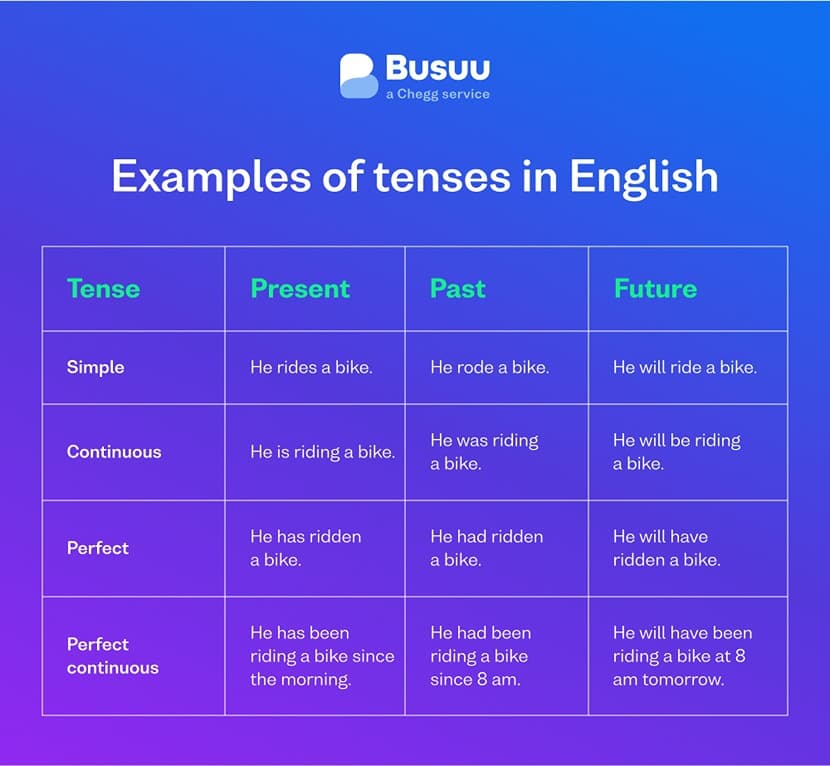
With the types of English tenses, rules and examples, you’re well on your way to mastering English tenses. Get practice using the English tense chart above and you’ll be able to use tenses in English to communicate more clearly.
But don’t stop there!
Here’s why you should learn English with Busuu
Let’s review what makes Busuu the best place to learn English grammar:
Learn with our Complete English course in US or UK English, or target your learning with dedicated courses like English for Travel, English Pronunciation or English for Exam Success.
Build your confidence with AI-powered features and exercises that encourage you to practice speaking out loud and writing freely.
Focus on the language skills you need with lessons designed by language-learning experts to be both efficient and effective.
Study with targeted smart review features that help you review the vocabulary and grammar you struggle with most and learn faster.
Build your confidence with feedback from a supportive community of learners and native English speakers.
AUTHOR
Emily Duncan
Newlanguages