I want to learn...
Author:

Emily Duncan
What is the TEF?
The TEF, or Test d'évaluation de français, is a French language assessment test. It was originally created by the Paris Île-de-France Regional Chamber of Commerce and Industry and is officially recognized by the French Ministry of National Education and Immigration, Refugees and Citizenship Canada.
The TEF tests a candidate's ability to understand and express themselves in written and spoken French. It assesses test takers on a 7-level scale that’s aligned with the CEFR (Common European Framework of Reference for Languages), with scores ranging from 0 to 6, from basic skills to fluency.
The primary difference between the TEF and the TCF is that the TCF only goes up to level 4 (advanced intermediate), whereas the TEF tests French speakers up to a more advanced level.
What is the TEF used for?
The TEF can be used for immigration, study or professional requirements in France, Canada, and the Canadian province of Québec.
Typically, TEF test takers include
Students applying for undergraduate or graduate school in France or Canada.
Immigrants to France.
Immigrants to Canada.
Applicants to work study programs, internships or job opportunities where French proficiency is a requirement.
More advanced speakers of French as a second language who want evidence of their proficiency level for any reason.
Preparation tips and best resources
Prepare for the TEF with Busuu and you’ll get access to the best practice resources for any skill level.

Study plans
Create a Study Plan with Busuu and get a ready-made schedule to meet your goals in time for your test date, with reminders for each planned study session.
The best practice resources
Study better with Busuu's award-winning platform, featuring bite-sized lessons designed by language learning experts for efficiency and effectiveness.
Section-specific strategies
Start at your CEFR level. Then use speaking practice lessons to work on your spoken French, or focus on comprehension with lessons featuring French media like Le Monde.TEF variants and purposes
There are four main TEF variants:
TEF Études
TEF Canada
TEF Québec (TEFAQ)
TEF Intégration Résidence Nationalité (IRN)
Read on to learn about each version of the TEF, including its purpose, format and who it’s for.
TEF Études
What is it?
The TEF Études is the TEF for students. It’s recognized as a qualifying test for the DAP (Demande d'admission préalable) procedure.
Who’s it for?
Foreign students applying to a French university for the first time.
TEF test format
Reading comprehension – 40 questions (60 minutes)
Listening comprehension – 40 questions (40 minutes)
Written expression – 2 sections (60 minutes)
Vocabulary and syntax – 40 questions (30 minutes)
Oral expression (optional) – 2 sections (15 minutes)
Maximum score: 699
What you need to know
To be eligible for university enrollment, you’ll need a score of at least 400 out of 699 in the four TEF written sections. The oral test is optional for the DAP.
TEF Canada
What is it?
The TEF Canada is for general Canadian immigration. It certifies a person’s French proficiency level using both the CEFR and the 12-level Canadian Language Benchmarks (CLB).
To immigrate to Canada or become a Canadian citizen, you have to prove proficiency in either English or French.
Who’s it for?
The TEF Canada certifies French language ability for French-speaking immigrants to Canada and Canadian residents hoping to become Canadian citizens.
TEF test format
For immigration:
Reading comprehension – 40 questions (60 minutes)
Listening comprehension – 40 questions (40 minutes)
Written expression – 2 sections (60 minutes)
Oral expression – 2 sections (15 minutes)
For citizenship:
Listening comprehension: 40 questions (40 min)
Oral expression: 2 sections (15 min)
Maximum score: 699
What you need to know
All sections must be taken on the same day for the scores to be counted for the purposes of Canadian immigration or citizenship.
For immigration to Canada, you’ll need at least either a CLB level 5 or 7, depending on the immigration program, and for citizenship you’ll need a minimum level of 4.
TEF Québec (TEFAQ)
What is it?
The TEFAQ, or TEF Québec, is specifically for immigration to the Canadian province of Québec. It is officially recognized by Québec’s Ministry for Immigration, Francization and Integration (MIFI). It grades test takers using both the CEFR and the Québec government’s 12-level French proficiency scale (the Échelle québécoise des niveaux de compétence en français, or EQNCF).
Who’s it for?
The TEFAQ is primarily used for immigration to Québec, but it can also be used to apply for Canadian citizenship, just like the TEF Canada.
TEF test format
All sections of the TEFAQ can be taken independently of the others, depending on your unique needs.
For immigration, some combination of:
Reading comprehension – 40 questions (60 minutes)
Listening comprehension – 40 questions (40 minutes)
Written expression – 2 sections (60 minutes)
Oral expression – 2 sections (15 minutes)
For citizenship:
Listening comprehension – 40 questions (40 min)
Oral expression – 2 sections (15 min)
Maximum score: 699
What you need to know
For immigration to Québec, the required sections and score vary based on which immigration program you’re applying for.
TEF Intégration Résidence Nationalité (IRN)
What is it?
The TEF Intégration, Résidence et Nationalité, or TEF IRN, is the version of the TEF used for French immigration and recognized by the French Ministry of the Interior.
Who’s it for?
The TEF IRN is intended for foreigners over the age of 16 who want to certify their French proficiency for the purposes of immigration, work, or becoming a citizen or French national.
TEF test format
Reading comprehension – 20 questions (30 minutes)
Listening comprehension – 20 questions (20 minutes)
Written expression – 2 sections (30 minutes)
Oral expression – 2 sections (10 minutes)
Maximum score: 499
What you need to know
Unlike the other TEF tests, the TEF IRN only tests up to CEFR level B2 and is scored out of 499. Minimum proficiency requirements were changed as of 2026, so the current minimum levels to qualify for French immigration are as follows:
Multi-annual Residence Permit: A2
Long-term Residence Permit: B1
French naturalization: B2
TEF exam structure and timing
Here’s a closer look at the sections of the various TEF formats.
General TEF modules
All versions of the TEF include a listening comprehension test, but it otherwise varies slightly. Here’s a little more about the five possible sections included in different versions of the test.
Reading comprehension
Tests your ability to read and understand written French
Multiple-choice questions
Listening comprehension
Tests your ability to understand spoken French using audio recordings
Multiple-choice questions
Written expression
Tests your ability to write in French
For TEF Études, TEF Canada and TEF Québec, you’ll be asked to complete two sections:
A) Continue writing an article – 25 minutes (80 words minimum)
B) Share and justify a point of view – 35 minutes (200 words minimum)
For TEF IRN, you’ll be asked to complete two sections:
A) Ask for news – 10 minutes (40 words minimum)
B) Explain a choice and convince the reader – 20 minutes (100 words minimum)
Vocabulary and syntax
Only on the TEF Études
Tests your ability to use French vocabulary and grammar correctly
Multiple-choice questions
Oral expression
Tests your ability to express yourself in spoken French
Completed face-to-face with an examiner
For TEF Études, TEF Canada and TEF Québec, your tasks will be:
A) Obtain information – 5 minutes
B) Share a convincing argument – 10 minutes
For TEF IRN, your tasks will be:
A) Make a request and ask about services – 5 minutes
B) Help a friend make a decision – 5 minutes
Five variants of the TEF
Here are the TEF sections at a glance for each variant of the test.
| Reading comprehension | Listening comprehension | Written expression | Vocabulary and syntax | Oral expression | |
|---|---|---|---|---|---|
| TEF Études | Required | Required | Required | Required | Optional |
| TEF Canada (immigration) | Required | Required | Required | N/A | Required |
| TEF Canada (citizenship) | Not required | Required | Not required | N/A | Required |
| TEF Québec (immigration) | Varies | Varies | Varies | N/A | Varies |
| TEF Québec (citizenship) | Not required | Required | Not required | N/A | Required |
| TEF IRN | Required | Required | Required | N/A | Required |
TEF scoring, results, and certification
Here’s a quick overview of what you need to know about TEF scoring, the result delivery timeline, and the certificate.
Scoring
All TEF tests provide a CEFR score from A1 (Beginner) to C2 (Mastery), except for the TEF IRN, which only goes up to B2 (Upper intermediate). In addition, the TEF Canada assigns a CLB score and the TEFAQ assigns an EQNCF score.
Timeline
TEF results take between one and 10 business days. Once you’ve received your results, you’ll be able to download your official certificate digitally. Paper certificates are not issued.
Certification
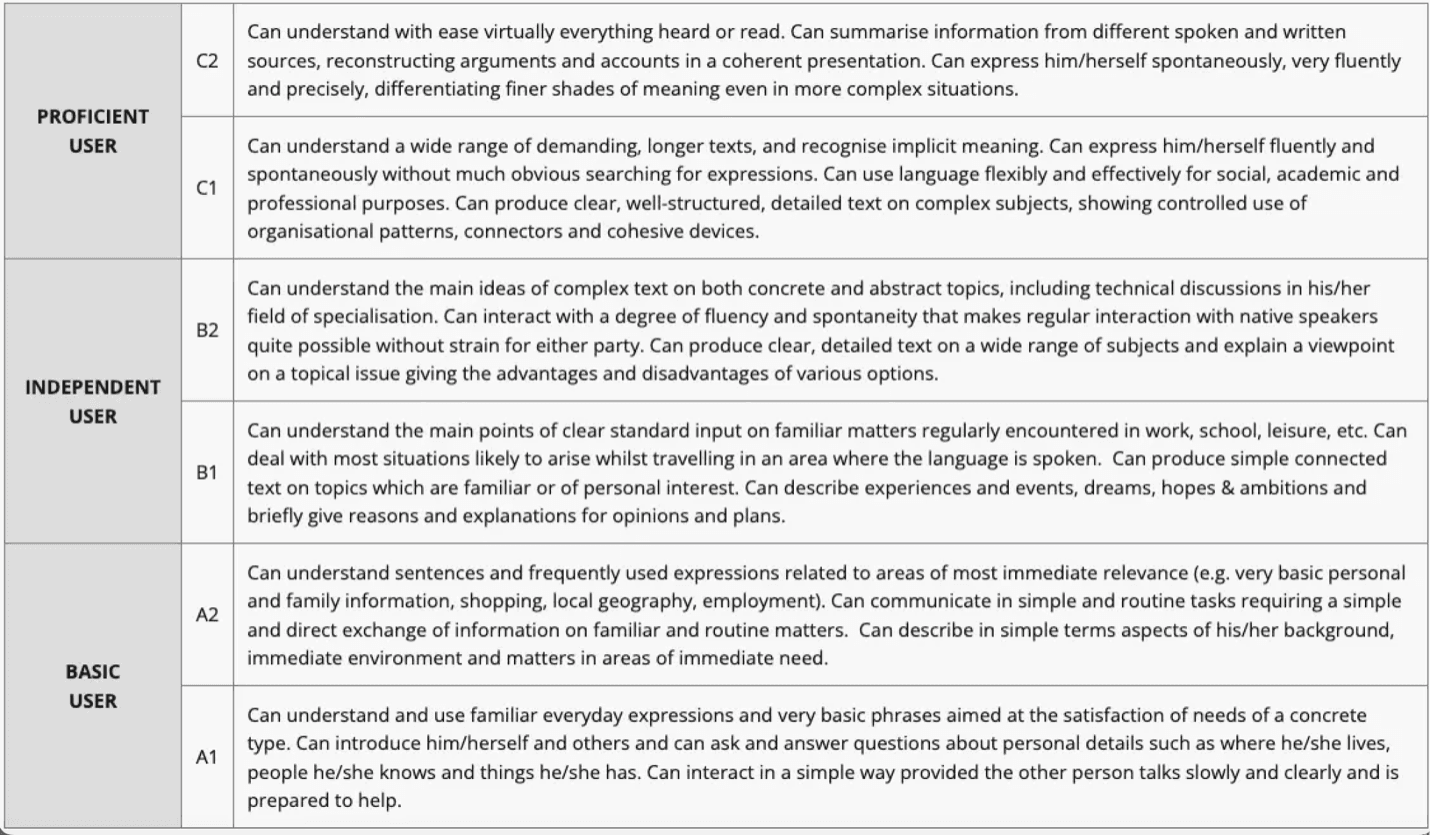
Your certificate will include your name, photo, signature, number of points scored, CEFR level achieved and a description of your current skill level in French. Results are considered valid for two years from date of issue.The TEF levels align with CEFR language proficiency levels, which are defined as follows:
TEF study tips
Here are three key things to keep in mind as you prepare for your TEF exam.

Brush up on your French
Spend time going over the grammar and vocabulary you’ve already learned, especially anything you’ve struggled with in the past.
Build your confidence
Lean on French media, study groups, and other tools to get practice listening, speaking French out loud, and writing.
Learn the format
Taking practice tests can be a big help for exams like the TEF. You don’t want to trip up on timing or misunderstand a question.AUTHOR
Emily Duncan
Newlanguages