I want to learn...
Author:

Emily Duncan
Thinking about taking AP Japanese? Already enrolled and wondering what the AP Japanese exam has in store for you? You’re in the right place.
In this AP Japanese study guide, we’ll look at the AP Japanese Language and Culture course as a whole, what to expect when taking the exam, and the best ways to study – including where to find practice tests and other resources so you can practice answering multiple choice questions and free response questions based on relevant readings and activities.
By the time you’re done reading this guide, you’ll have the tools you need to ace the AP Japanese exam.
Here’s how Busuu can help you study for AP Japanese

Build Fluency
Get speaking and writing practice with free response prompts and build your vocabulary and Japanese cultural understanding with bite-sized lessons you can take on the go.
Study Smarter
Put the algorithm to work for you with Busuu’s Smart Review feature, which automatically collects what you’ve learned and prompts you to review it strategically to remember more come exam time.
Gain Confidence
Get feedback on your exercises from native Japanese speakers. Learn to speak more naturally and build the confidence you need to put your Japanese learning to use in any situation.AP Japanese: The Basics
To get started, let’s take a closer look at the AP Japanese Language and Culture course overall.
What is AP Japanese?
AP Japanese is an Advanced Placement (AP) class, designed for US high school students to take classes at a college level to gain college credit or – quite literally – advanced placement in college courses when they arrive at their college or university.
That means, for example, that a high mark on an AP exam may qualify someone who would otherwise have to take beginner Japanese as a prerequisite to taking Japanese courses in college to skip ahead and take more advanced classes from the get-go.
AP Japanese is considered an intermediate Japanese course on a college level and equivalent to B1-B2 level Japanese when following the Common European Framework of Reference for Languages (CEFR).
What do you learn in AP Japanese?
The Japanese AP course is centered around teaching students to think and communicate in Japanese. It’s a course designed for students who have already learned some Japanese to develop fluency and cultural awareness.
The primary themes covered in AP Japanese are:
Families and communities (ex. Citizenship, diversity, relationships)
Personal and public identities (ex. Stereotypes, generational issues, national identity)
Beauty and aesthetics (ex. Fashion, architecture, literature, visual arts)
Science and technology (ex. Healthcare, scientific research, technologies)
Contemporary life (ex. Current events, careers, social customs)
Global challenges (ex. Economics, environmental issues, politics and history)
And students are graded on their ability to:
Understand and interpret Japanese texts and audio recordings
Draw connections using cultural context and an understanding of different disciplines as explored in the course
Successfully create meaning from words and expressions in Japanese
Speak with and write to others in Japanese
Giving oral and written presentations in Japanese
While this is the same as many other AP Language & Culture courses, Japanese is considered a uniquely difficult language for English speakers, especially given the difficulty of mastering Kanji and written Japanese, and a good grade may require more study for non-native speakers.
What do you need to know to do well in AP Japanese?
Most students that excel in AP Japanese have significant experience with the Japanese language, either having personal experience with the language or having taken several years of Japanese before beginning the AP course.
By the time they take the AP Japanese test, students are expected to have learned roughly 410 kanji. The good news is, the entire list is shared at the very end of this resource document from AP.
In general, students should be able to read and listen in Japanese and understand enough to respond to materials orally or in writing with accuracy and clarity.
Frequently asked questions about the AP Japanese exam
Here are some key details you need to know about the AP Japanese Language and Culture exam.
What is the AP Japanese exam format?
The Japanese AP test is a little different from the exams for other AP languages. It’s broken into 2 sections, as follows:
Section I (70 questions)
Part A: Multiple choice questions – listening (30-35 questions)
Part B: Multiple choice questions – reading (35-40 questions)
Section II (4 questions)
Question 1: Text chat – responding to a series of text messages
Question 2: Compare and contrast article – composing a 300-400 character article contrasting two related topics or two opposing sides on a single topic
Question 3: Conversation – 20 second spoken free responses to 4 prompts in Japanese simulating an interpersonal conversation
Question 4: Cultural perspective presentation – present a view on a given Japanese cultural practice or product (4 minutes to prepare, 2 minutes to present)
How long is the AP Japanese exam?
While most AP language exams are over 3 hours long, the Japanese exam is just 2 hours long.
Time is allotted by section:
Section I (70 questions)
Part A: 20 minutes
Part B: 60 minutes
Section II (4 questions)
Question 1: 10 minutes
Question 2: 20 minutes
Question 3: 3 minutes
Question 4: 7 minutes
What are you tested on in the AP Japanese exam?
When you take the AP Japanese exam, you’re tested on your ability to:
understand written and spoken Japanese
demonstrate that understanding by correctly answering multiple choice questions
use written and spoken Japanese in a variety of contexts and via different modes of communication
draw connections between things you’ve learned about Japanese culture during the course
apply Japanese vocabulary, idioms, and grammar accurately to make yourself understood
Study for the AP Japanese exam with Busuu
Busuu isn’t just another online Japanese course. Busuu’s lessons are designed by language learning experts and align with the content and aims of AP Japanese. Simply take a proficiency test to leap to the right level and start practicing with Busuu’s bite-sized Japanese lessons.
Listening & Reading
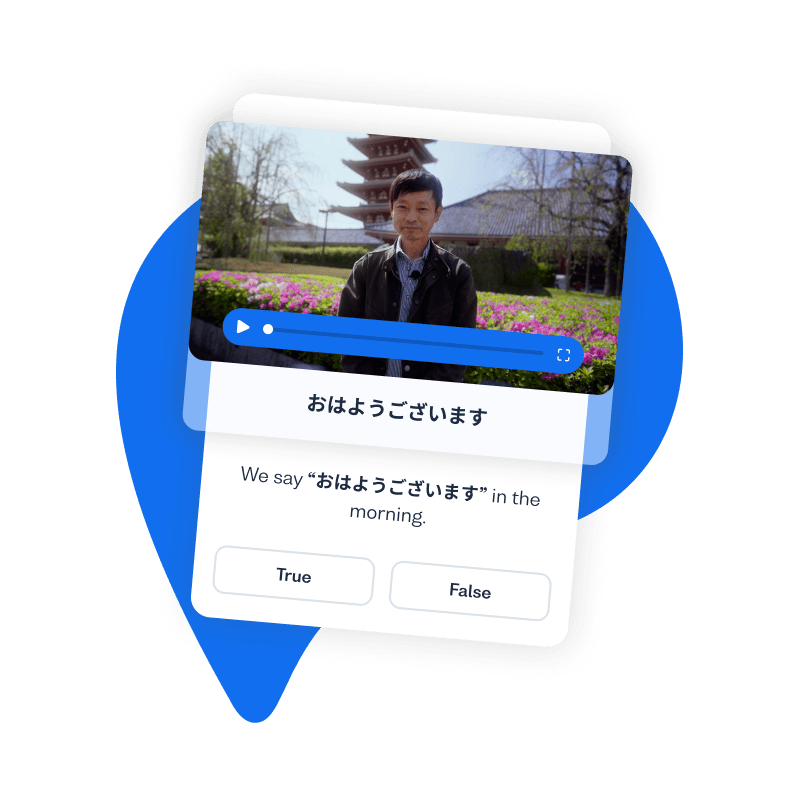
Practice answering multiple choice questions based on readings, dialogues, and audio recordings at an intermediate level (B1/B2).
Productive Skills
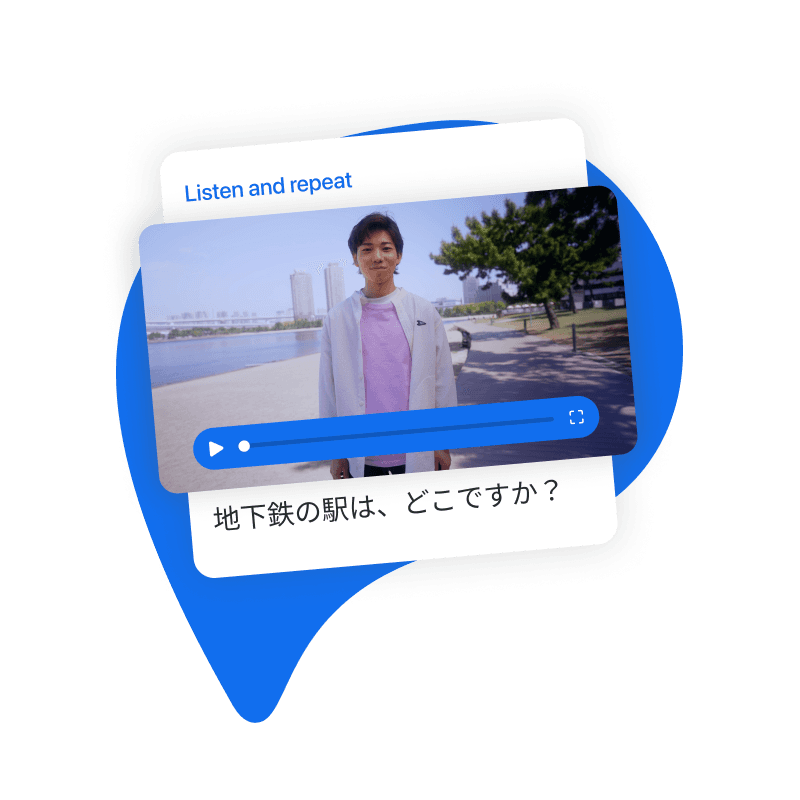
With the Conversations feature, you’ll be prompted to compose written or spoken free response answers to prompts as you learn.
Cultural Context
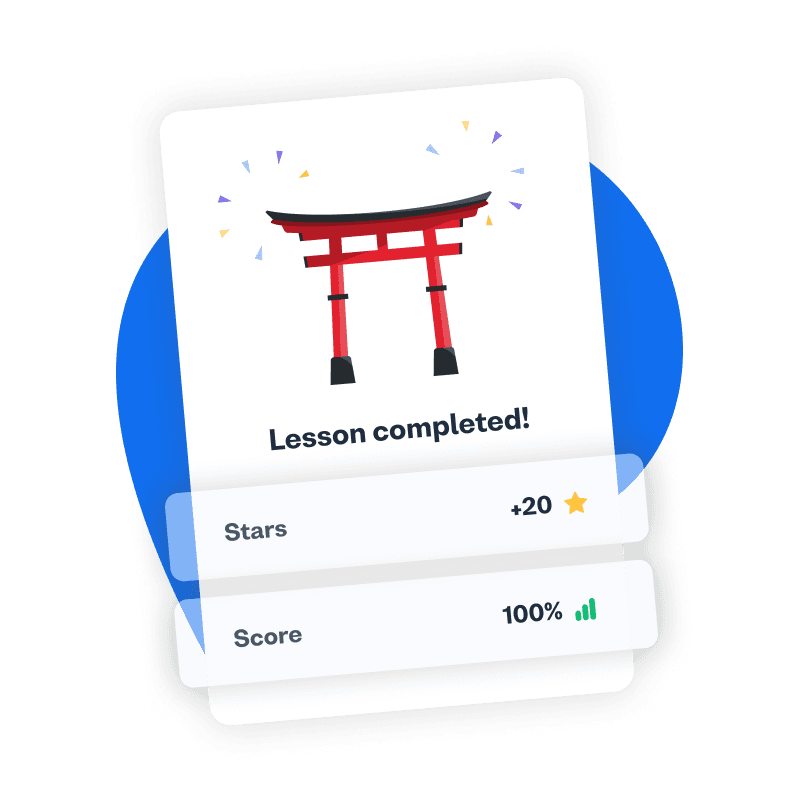
Busuu’s lessons don’t stop at vocabulary. Lessons cover important topics about Japanese art, culture, social norms, and more.
Ready to excel in your AP Japanese exam?
Use these tips and resources to help you prepare.
Review past exams
The AP website has tons of great resources to help you prepare for your exam using AP Japanese past exams.
Here’s a breakdown of what to expect from 2021 with sample questions.
Here are free response questions from previous exams with top answers.
And here’s a comprehensive document about the course with the exam grading rubric and sample exam questions (exam information begins on page 150).
Practice the skills you’ll be tested on
While it’s hard to find a complete AP Japanese practice test online, you can certainly make your own out of the resources above, or drill all the skills you’ll be tested on using Busuu.
On Busuu, you’ll practice all the skills you’ll need for the exam and review many of the most common kanji you’ll need to know for the final test.
Use spaced repetition to master more kanji
For many Japanese learners, unless you’ve grown up speaking Japanese or have a background in Mandarin Chinese (which has some overlap in characters), memorizing kanji will be one of the trickiest parts of preparing for the AP Japanese exam.
That’s why our language learning experts recommend studying using something called spaced repetition.
Spaced Interval Repetition is a method of learning where you study in short, frequent bursts, then review what you learned over time at strategically spaced intervals to help you retain more of what you learned. Those intervals are calculated based on a projected “forgetting curve” – where you’re reminded of something at just the right time to ensure you don’t start to forget it.
Studies have found that spaced repetition is much more effective than cramming when it comes to retaining information long term, so it can be really helpful when you need to remember a ton of information that you’ve learned over a semester or longer period of time (like, for example, over 400 kanji!).
When you learn with Busuu, you’ll automatically be prompted to review older information based on spaced repetition so you can focus on preparing for the exam rather than drilling your kanji and Japanese vocabulary at the last minute.
Learn with Busuu
When you learn with Busuu, you’ll get:
Lessons made for your proficiency level, designed by language learning experts
Built-in spaced repetition and review tools that automatically capture what you need to practice from your exercises
Mnemonics to make Japanese character memorization easier
Multiple choice practice questions based on relevant readings, audio recordings, and dialogues that give cultural context and teach about Japanese culture
Spoken and written free response practice, plus AI-powered speaking practice
Feedback from native Japanese speakers to help you build fluency and confidence
And best of all, you can start learning with Busuu for free!
And that’s what you need to know about AP Japanese
Now you have all the resources you need to study for – and ace – the AP Japanese exam. All that’s left is for you to put them to work.
がんばってください!
AUTHOR
Emily Duncan
Newlanguages