I want to learn...
Author:

Barney Meekin
Vocabulary is a massive part of learning German. It’s the foundation you build all your other skills on. When you’re a beginner, you should focus most of your attention on vocabulary. Sure, grammar is important, too. But you can communicate with poor grammar if you know the right words. Increasing your vocabulary is still important even when you become a more advanced German speaker. With thousands of words, the learning never ends.
Memorizing all the words you learn and encounter is a challenge. But it’s a challenge we’re here to help you overcome. In this article, you’ll learn 10 top tips to help you learn German vocabulary. And you’ll find out why Busuu is the best app for learning German.
The benefits of building your German vocabulary
Improve your communication skills
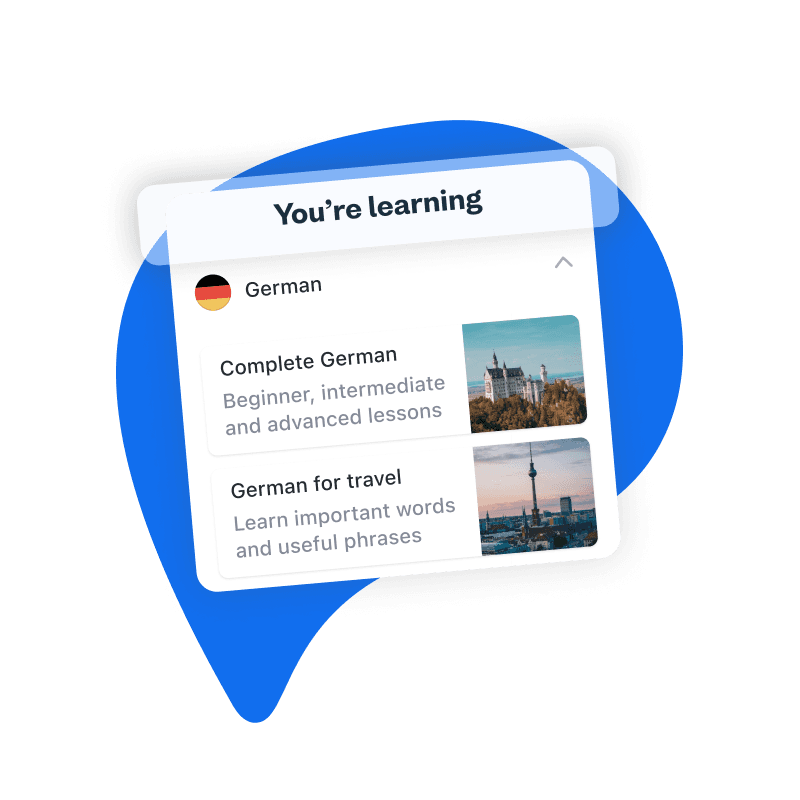
The more German words you know, the easier you can express yourself. You know the right words for the right situations. You have the tools to choose how you want to say something. And you’ll be able to understand complex conversations and texts. Busuu’s Complete German course takes you from beginner to advanced. So you always know what to say.
Have more confidence
Communicating in a new language can be scary—especially when you don’t know enough words. Increasing your German vocabulary means you're less likely to worry about making mistakes. You spend less time searching for the right words. And you don’t need to check your dictionary constantly. You have more confidence to get out there and use your new German skills in real life.
Hit your goals—whatever they are
Busuu Premium has German courses for every need. Complete German gives you all-round skills. German for Travel teaches you the basics to make your trip to Central Europe memorable. German for Business helps you get ahead professionally. And Life in Germany teaches you the language and cultural tips for settling into Germany. Whatever your goals are, Busuu can help.10 Top tips for mastering German vocabulary
1. Focus on the most frequent words
Mastering everyday German vocabulary should be your first goal. You don’t need fancy, complicated words. Focus on learning the most frequent 100 words. Then, the most common 500 words. Then, the most common 1,000 words. And so on. Estimates say if you know the 2,000-3,000 more frequent words, you can understand around 85% of all conversations.
You can find word lists all over the internet. Do a Google search for “the most common German words” and use the information you find as your starting point. Remember, getting to the 2,000-3,000 word point means you’ll be a high-level German speaker. So don’t rush. It will take time to get there. But when you do, you’ll be able to do anything you want in German.
To help you identify which words you should learn, join Busuu’s Complete German course. It’s full of vocabulary to learn at each level, from beginner to advanced.
2. Learn words in context
To really understand a word, you need to see or hear it in context. The best ways to do this are speaking, reading, and listening. Conversations with German speakers will show you how and when to use words. You’ll learn things you can’t find in a dictionary, like interesting regional differences or slang words.
Combine this with lots of reading and listening. “Lots of” is important here. The more input you have, the faster you’ll learn. Split your exercises into extensive and intensive ones. Extensive reading and listening focus on meaning. Choose easy and interesting texts. Don’t focus too much on vocabulary. You’ll learn them naturally by doing a lot of these exercises.
Intensive reading and listening exercises focus on the language instead of the meaning. Choose more difficult texts. Take your time and analyze the language. Look at how words fit into sentences, how they combine with other words, and how meaning changes depending on the situation.
Graded readers, blogs, and podcasts are examples of texts you can read/listen to both extensively and intensively. The internet is your friend here—you can find many German texts to practice with.
When you’re a beginner, reading will be easier than listening. You can slow down to think because you can read at your own pace. You have time to think about meaning. With the fast pace of listening, this is much harder. So, only add listening exercises when you’re more comfortable.
3. Guess the meaning before looking at the dictionary
Don't look at the dictionary when you see or hear a new word. I know this sounds strange, and checking the dictionary is a natural impulse in this situation. But don’t. Instead, write down the word. Guess its meaning from the context: Think about the words, sentences, and paragraphs around the word.
Check your ideas in a dictionary after reading or listening to the text. Don’t let your dictionary interrupt the flow of your reading and listening practice.
4. Use spaced-repetition
Spaced repetition is a fantastic way to memorize vocabulary. The more times we see a word, the less likely we are to forget it (this is another reason extensive reading works so well). With spaced repetition, you repeatedly review and test your knowledge of words over increasing periods of time.
Here’s a simple example of spaced repetition:
| Day 1 | Learn new word |
|---|---|
| Day 2 | Review word |
| Day 7 | Review word again |
| Day 16 | Review word again |
| Day 32 | Review word again |
| And so on. |
Doing spaced repetition takes a lot of organizing. So, it makes sense to use apps and computers instead. They automatically save words, remind you to review them, and track your progress and performance.
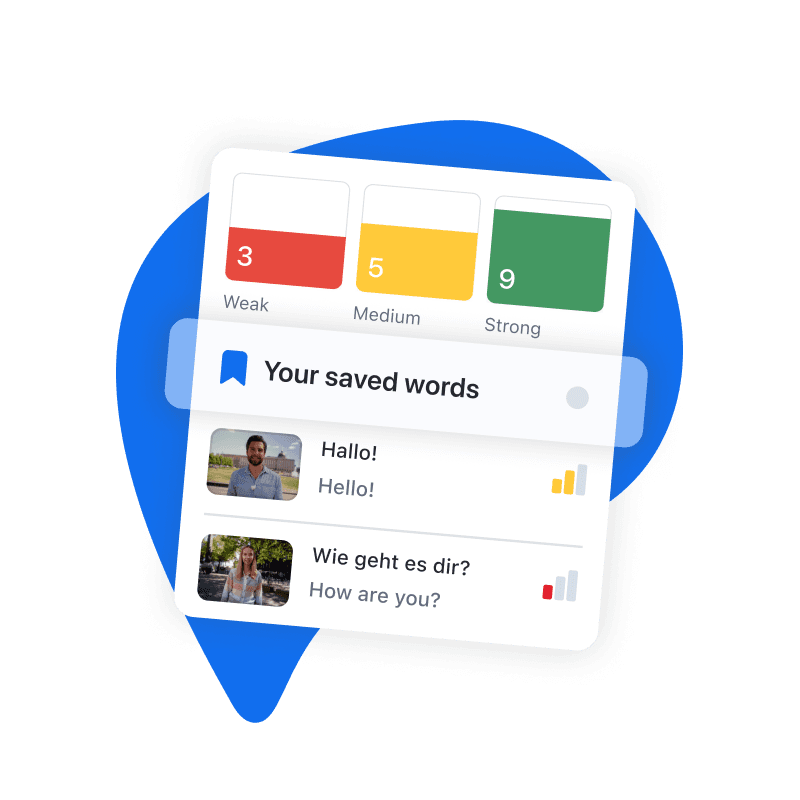
For example, Busuu’s Vocabulary Review tool automatically tracks all the words you’ve learned in your German courses. It uses a spaced-repetition algorithm to help you remember them. It tracks your performance on reviews — words you’ve mastered are labeled Strong and appear less frequently. Words you struggle with are labeled Weak and appear more frequently. This way, you don’t waste time learning words you already know.
5. Use flashcards
Flashcards are an effective way to organize your vocabulary learning and remember words. Write the new word on the front and the definition on the back. Test your knowledge by only looking at the front and trying to remember the definition. You can combine flashcards with spaced repetition easily.
Don’t buy pre-made sets, though. Make your own with words that you are learning and are relevant to you. Again, using an app makes this easier. Busuu’s Vocabulary Tool automatically tracks the words you’ve studied, so you don’t need to spend time making your own flashcards.
6. Learn new words every day
Not only is this habit-forming, but it also leads to a surprisingly large number of new German words when you do it consistently. One or two new words per day don’t sound like a lot. But do that every day for two years and you’ll learn a lot of new words. Without realizing it, you’ll increase your vocabulary with as little as five minutes of daily study. Combine this with the two points above to make it even more effective.
7. Make a vocabulary journal
I know, I know. This isn’t glamorous. It’s a simple but effective way to help you memorize German words. Add every new word to a notebook. Include the part of speech, meaning, pronunciation, and example sentence. For a deeper understanding, also add words with similar and opposite meanings. Review this regularly, and you’ll make significant progress.
8. Use the words you learn
Now, we get to the fun bit. You’ve learned all these words for a reason: To use them. You get to communicate in German, and you reinforce your vocabulary knowledge, helping you memorize words and learn new ones. Of course, speaking is a great and fun way to do this. But don’t worry if you don’t have any people to practice with because writing is just as effective. So, write stories, social media posts, poems, journal entries, etc. Be creative and make it fun.
9. Use an app
Flashcards and vocabulary journals are simple, effective tools. But apps are more accessible and convenient. Busuu’s Vocabulary Trainer, for example, automatically saves all the words you’ve learned during your German courses. You can see them, review them, and take quizzes. The Strengthen Vocabulary feature shows you the words you struggle with so you can practice the words that need extra attention.
10. Have fun
Want to increase your German vocabulary? You need to consistently, over a long period of time, study German vocabulary. It sounds tough, but it doesn’t have to be. Have fun when you’re learning German vocabulary, and it’ll be easy to stay consistent. Be creative when using your new words. Listen and read to topics you’re interested in that are relevant to your life. Find interesting people to communicate with.
Find ways to make learning German vocabulary fun, and you’ll make fantastic progress.
Why Busuu is the best place to learn German vocabulary
A thriving and supportive community
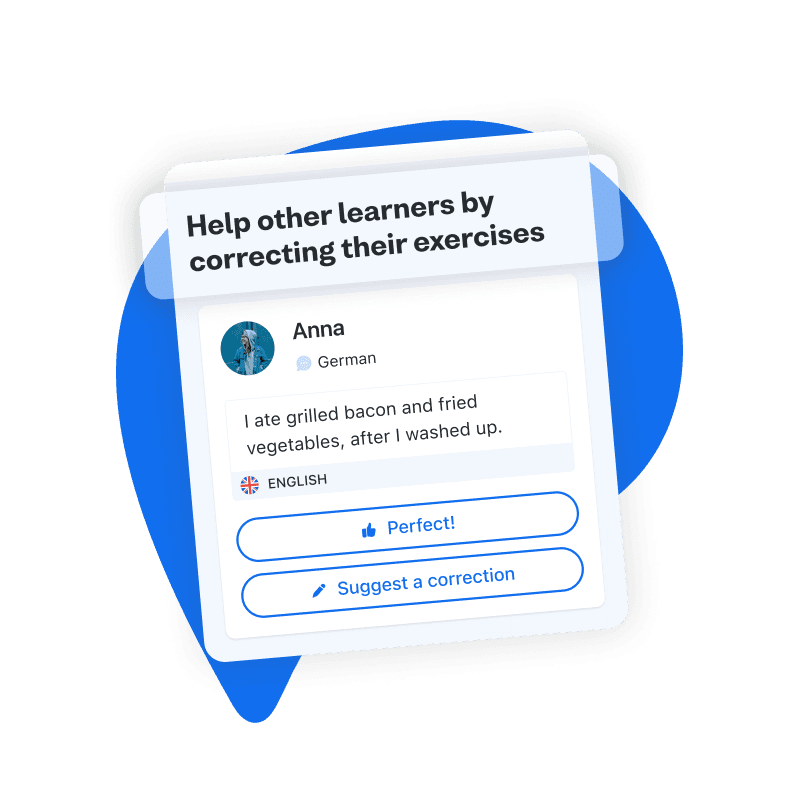
Get feedback from native German speakers in the Busuu community. Join millions of language learners supporting and helping each other. Share your German for feedback on your vocabulary, writing, and speaking skills.
An easy-to-stick-to, sustainable habit
Busuu’s easy-to-follow, bite-sized lessons mean learning German isn’t a chore. You can squeeze it into your day and take it on the go with our handy mobile app. You get all the tools you need to make a consistent habit.
Advanced language learning tools
Busuu’s spaced-repetition algorithms help you increase your German vocabulary. The Busuu app automatically tracks the words you’ve learned and your progress. Busuu uses this data to give you personalized language learning. No more wasting time—study the words you need to study at the perfect time to aid memorization.
Learn German vocabulary today with Busuu
Want better German communication skills and more confidence? It’s time to increase your vocabulary. But don’t worry—Busuu’s here to help. With a range of courses for every need, bite-sized video-based lessons, and a thriving online community, you will achieve your German goals with Busuu.
AUTHOR
Barney Meekin
Newlanguages