I want to learn...
Author:

Emily Duncan
There are plenty of good reasons to want to improve your Spanish conversation skills. Whether you’re trying to make the grade in AP Spanish, visiting Mexico for vacation, or just hoping to connect with a Spanish speaker in your life, these tips can help you reach your goals.
You might think that you need real-life Spanish conversation practice to improve – and that’s true, to a degree – but there are plenty of things you can do to sharpen your conversational Spanish from anywhere. Even if you only have a few minutes a day, this guide will help you find ways to keep making progress toward your Spanish learning goals.
Let’s take a look.
15 ways to get better at Spanish conversation

While not all of these tips and tricks will work for everyone, there should be something on this list that’ll help you brush up your conversational Spanish.
1) Put Spanish movies and TV shows to work for you
If you’re working on mastering basic Spanish conversation, it’s important to learn to listen and understand the way real Spanish speakers use the language. What you learn from classes and online courses is important, but real people tend to speak quickly and string words together in unexpected ways.
The good news is, you can use Spanish language content to help bolster your listening skills and build your vocabulary of real world phrases and slang. Of course, you want to be careful who and what you copy when watching Spanish language TV shows and movies – just like you’d be better off learning English from Friends than South Park – but it’s a great way to get used to different Spanish accents and how casual Spanish is spoken day to day.
We recommend rewatching the same episode or film a few times, alternating between English subtitles, Spanish subtitles and no subtitles, and looking up any unfamiliar words or phrases until you can understand what’s being said on your own.
Want to try it? Check out our lists of the best Spanish series and the best Spanish movies on Netflix right now.
2) Drill dialogues
Looking for something a little simpler? One great, easy way to improve your conversation in Spanish is through dialogue exercises. When you learn with Busuu, your lessons include dialogues you can listen to, read and answer questions about.
Busuu’s content is designed by language learning experts to help build skills and vocabulary, making these dialogue activities particularly handy in the context of their lessons.
3) Talk to yourself in Spanish
If you need to practice Spanish conversation but don’t have anyone to talk to, why not talk to yourself? Practice narrating your day out loud when you can, or think through how you’d describe what you’re doing.
This can help you get used to pronouncing Spanish words and discover necessary vocabulary you haven’t learned yet or that hasn’t quite stuck. Focusing on describing your day can also help you think on your feet in Spanish, so you’re not stuck to scripted conversations from your lessons.
Pro Tip: Want to practice speaking out loud, but not interested in talking to yourself in public? Pretend to make a phone call and have a one-sided conversation in Spanish. You might feel a little silly, but finding ways to be brave as you learn a new language can help you overcome one of the biggest challenges learners face when first trying to use their new language skills – fear.
4) Listen back to your exercises
Another way to polish your conversational Spanish is to record yourself and listen back.
This can work in two ways. First, you can listen to recordings of the things you need to work on the most. Create a study plan just around the words you struggle with, and get creative with exercises for yourself.
Second, listening to a recording of yourself can make it easier to hear places where you’re tripping up or where your pronunciation could be improved. It’s easier to spot these errors when you’re listening back than when you’re trying in real time to say something in Spanish.
On Busuu, you’ll often have the opportunity to record your responses to exercise prompts. Speaking a language out loud as often as possible is important to ensure your conversation skills grow alongside your reading, writing and listening skills.
5) Take notes
On a similar note, to give your Spanish practice a boost, one of the best things you can do is keep track of new phrases, words and concepts you learn, plus anything you find difficult or struggle to remember.
If you’re learning on your own, a great way to do this is to have a designated notebook just for your Spanish learning. You can use it to record things you learn from your TV watching and conversations so you can review them later.
What’s a faster way to keep track of things you need to practice? Busuu’s Smart Review feature. Smart Review automatically tracks grammar and vocabulary you stumble on in your learning and organizes everything you need to study, making it easy to focus on the areas where you need the most practice.
6) Learn while you scroll

Who says language learning has to be boring and stuffy?
Harness social media to get Spanish speaking practice without even thinking about it! Follow Spanish language accounts and language learning accounts to help you learn in your downtime.
Just like English, written Spanish ranges from academic writing and formal business emails to Spanish slang and texting lingo that might be almost unrecognizable to beginning Spanish learners. By using social media, you can learn to understand casual written Spanish. This will help you have better Spanish text conversations with Spanish speakers.
If you haven’t already, you can even follow Busuu for fun language content!
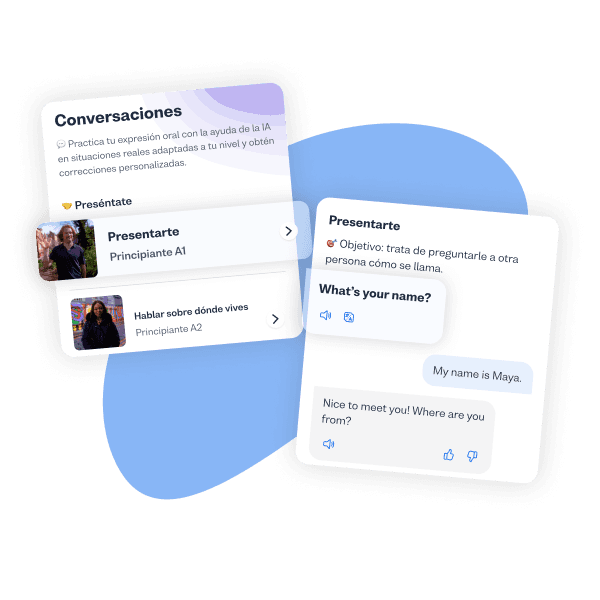
7) Take advantage of online courses (like Busuu!)
There are tons of resources online for people who want to learn Spanish. But if you want the best app for Spanish conversation, Busuu is a must-try.
With dialogue drills, speaking and pronunciation exercises, content from Spanish newspapers and podcasts, exercises designed by experts, smart review features, and feedback and encouragement directly from native Spanish speakers, Busuu is the best app to help you speak Spanish fluently.
And best of all, you can learn Spanish for free on Busuu!
Spanish conversation practice tips, continued

Thought we’d run out of tips and tricks? Think again! Keep reading for more ways to boost your conversational Spanish.
8) Commit to a specific goal
For many learners, simply committing to practice Spanish in general isn’t always enough. Setting specific goals for yourself can help you stay motivated and put together a learning plan to reach those goals.
For example, rather than saying, “I’m going to get better at Spanish this year,” saying “I’m going to get my A2 Spanish certificate by December 1, 2024” can help you give more direction and add a timeline to your studies.
With Busuu, lessons are grouped by level, from A1 (beginner) to C1 (advanced) Spanish, developed according to the Common European Framework of Reference (CEFR), an internationally recognized standard for language learning. Each level culminates in a test and, if successfully passed, a Busuu Certificate.
9) Make practice a habit
Speaking of setting a schedule to hit your goals, our language experts recommend not just choosing a goal, but creating a study plan to reach it. That means creating a schedule for what you’ll study and when.
After all, if you want to have better Spanish conversations, you need to spend time working on your conversation skills.
When you learn with Busuu, you can set up a Study Plan with a specific goal and timeline, and the app will automatically suggest how often you need to study. You can then choose when you’ll study and set reminders.
If you’re having trouble fitting studying into your routine, one of our expert tips is to pair lessons with something you already do daily. For example, if you always take a coffee break at the same time, make it coffee and a Spanish lesson. Folding study time into your existing routines can help make it easier to stick to your plans and reach your goals.
10) Build your vocabulary with books and music
Another way to improve your conversations in Spanish is to build your vocabulary using books and music. Poetry, books and Spanish songs new and old can all help you better translate your unique personality into Spanish.
Of course, as with TV and movies, you’ll want to be prudent about using this tip! Make sure you’re using the language appropriately – you don’t want to swing too old-fashioned by only reading books from the 19th century or accidentally saying something edgier than you mean to.
A Spanish speaking buddy, tutor, or even Google can be your friend here – as well as the feedback you’ll get from native speakers when you practice with Busuu.
11) Chat with AI assistants
Sure, you’re probably learning Spanish conversation to speak with humans – but why not let the robots help you a little in the meantime? You can change your default language and use tools like Siri, Alexa, ChatGPT and others to have real conversations in Spanish – or something like it – even when there are no Spanish speakers around.
If you’re far enough along in your Spanish studies that you won’t get stuck, you can even set the default language on your phone or computer to Spanish and build Spanish practice into your everyday routines.
Pro Tip: Already speak some Spanish? With Busuu, you don’t need to start from scratch – you can take a placement test when you start and jump right into the right course level for your Spanish skills.
12) Work with a teacher or tutor
When it comes to Spanish conversation practice, you can get pretty far on your own, but sometimes there’s just no replacement for expert, one-on-one human guidance.
Whether you’re stuck on some complicated grammar or just need practice chatting with an actual Spanish speaker, an experienced Spanish tutor can be a huge help.
If you’re in need of expert guidance that works with your schedule, find your tutor on Verbling.
13) Listen and learn
If you want to learn useful Spanish phrases for conversation, the news, radio and podcasts are your friend. They’re a great way to learn how regular people speak and build your vocabulary around current events and modern technology.
When you learn Spanish with Busuu, you’ll get access to advanced Spanish lessons created in partnership with the Spanish newspaper El País.
14) Bring your studies with you
Practicing Spanish doesn’t have to be limited to just your home or the classroom – you can learn on-the-go with Busuu. The Busuu mobile app allows you to learn from anywhere, and with Busuu Premium, you can download lessons to keep learning even when you don’t have an internet connection.
15) Get feedback from native speakers

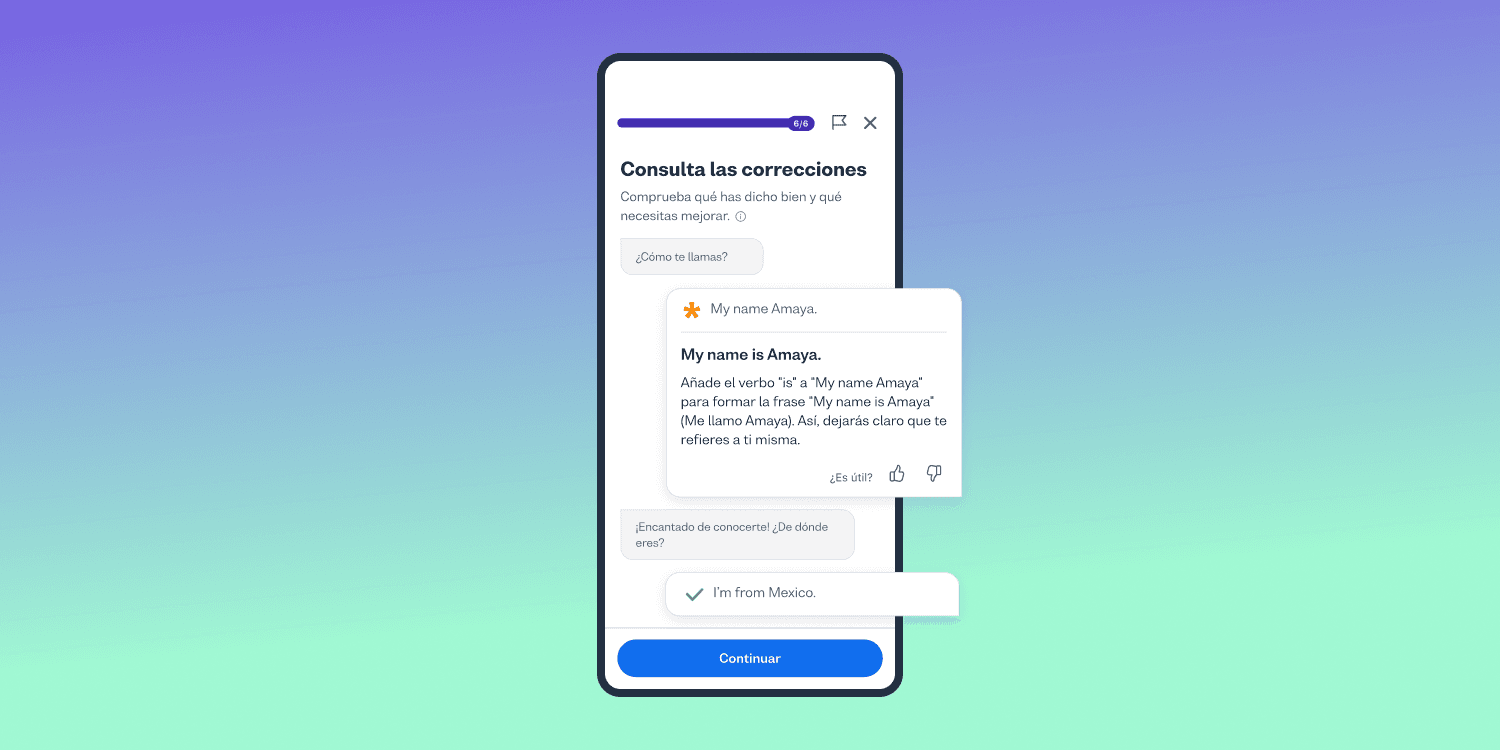
Last but certainly not least, if you want to learn conversational Spanish, one of the absolute best things you can do is find native Spanish speakers willing to give you direct feedback as you learn. Fortunately, on Busuu, that’s exactly what you’ll get!
Busuu’s online Spanish courses feature a combination of self-driven, bite-sized lessons and conversation exercises shared with the Busuu community, allowing you to get regular help and encouragement from native Spanish speakers.
Learning with the help of real Spanish speakers means you can polish your pronunciation with human feedback, get insight into how real Spanish speakers phrase things, and start to tackle any anxiety you have about speaking Spanish. This will ensure that you’re well prepared to participate in Spanish language conversation.
And one bonus tip: Take the leap and make conversation
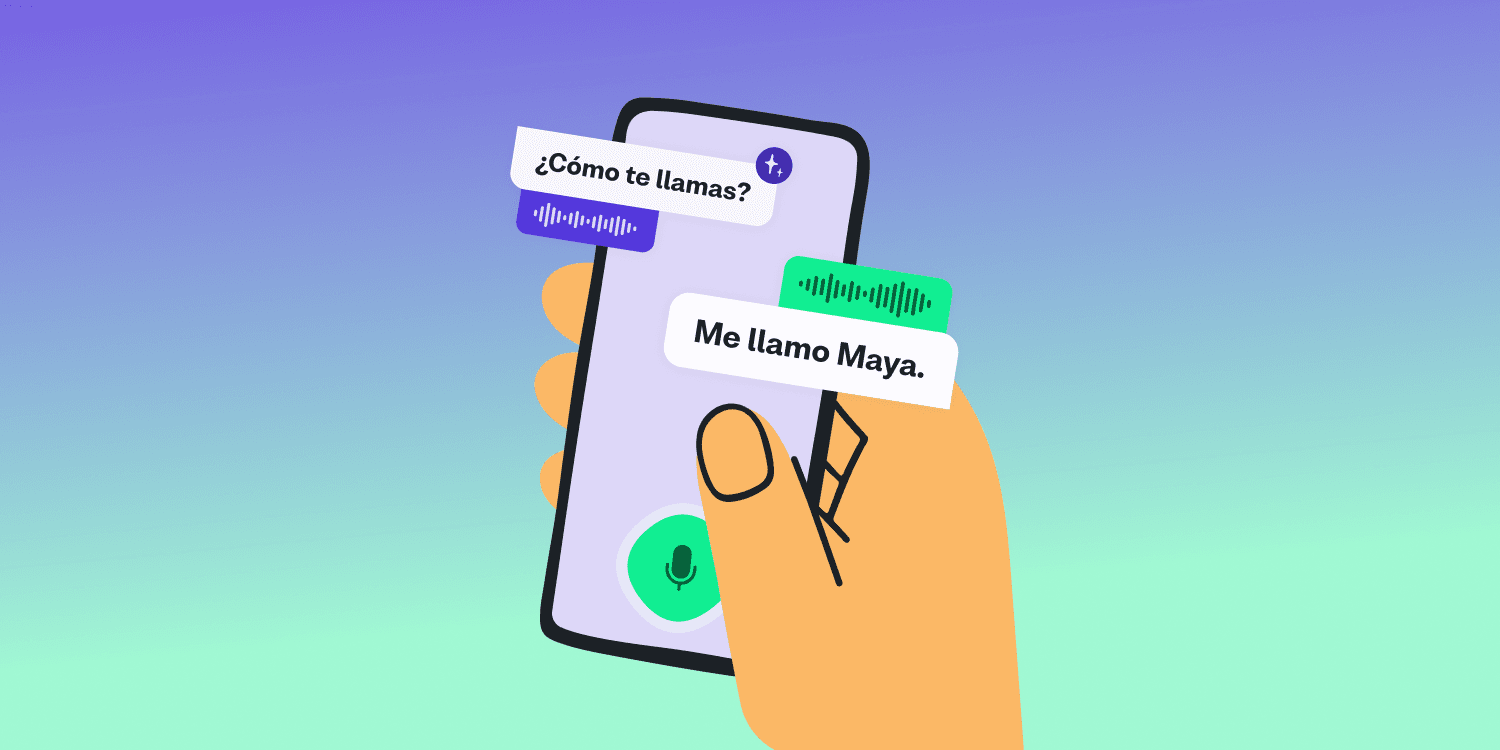
Now you know tons of ways to brush up your Spanish conversation skills anytime, anywhere. But there’s one more thing you can do to work on your Spanish – go out in the world and try it!
Whether you have a trip planned, or you know a Spanish cultural center or family-owned Mexican restaurant in your hometown where you can find real Spanish speakers, seek out Spanish conversation and start talking. There’s no time like the present!
Practice Spanish conversation with these topics

Now we’ve covered how to practice. But what exactly should you be practicing? Here are a few topics that make sense for learners wanting to practice Spanish conversation, grouped by A1 (beginner), B1 (intermediate) and C1 (advanced) levels.
Basic Spanish conversation topics for beginners
Introducing yourself – hello, how are you, my name is, I am from…
Languages you speak
Family members
Jobs (basic)
Likes and dislikes (basic)
Intermediate Spanish conversation topics
Music recommendations
Sharing anecdotes
Vacations and travel
Life events
Advice
Advanced Spanish conversation topics
Food culture and fine dining
Art and cinema
Advanced job topics, business and finance
Scientific developments and the sciences
Politics and news
Ready to work on your conversational Spanish?
Those are all of our tips to take your Spanish from meh to muy bien.
With a little hard work, you can become a great Spanish conversationalist. There’s only one thing left to do – put these tips and tricks into practice!
AUTHOR
Emily Duncan
Newlanguages