I want to learn...
Author:

Barney Meekin
No matter what your reasons for learning Japanese, you likely want to know how to learn Japanese fast. Whether you’re preparing for a trip to Tokyo or you're an anime superfan, learning Japanese will be a rewarding experience. It won’t be easy. But it’ll feel great when things finally start to click.
It takes time to master any language. There are no shortcuts to learning Japanese. And it definitely won’t happen overnight. But that doesn’t mean there aren’t things you can do to speed the process up. In this article, you’ll discover ten tips on how to learn Japanese faster, more efficiently and more effectively so you can reach your Japanese goals as quickly as possible.
Discover how to learn Japanese quickly
Learning Japanese can be overwhelming. But it doesn’t need to be. Follow these tips, and you’ll see real progress in your Japanese skills.
1. Choose the right course
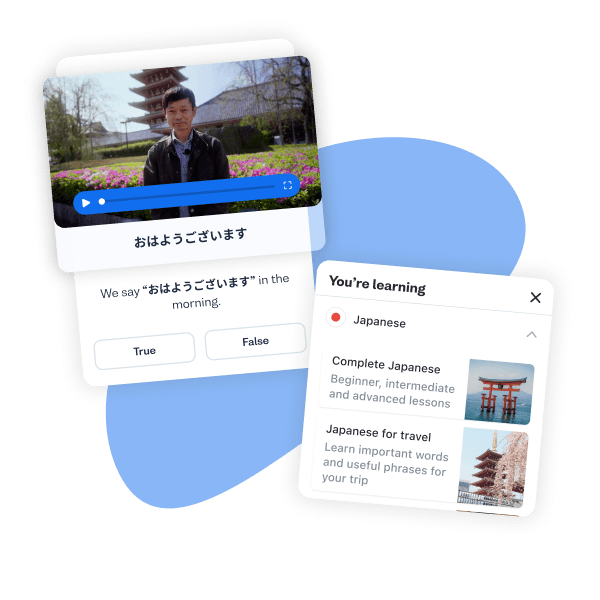
Taking an effective course is a fantastic way to learn Japanese. Which course you choose depends on your goals and your current ability. Taking courses that aren’t related to your goals – or are too easy or difficult – is a guaranteed way to stall your progress.
Busuu’s Japanese courses are designed by language-learning experts and cover everything from beginning to advanced Japanese.
If you’re completely new to Japanese, check out Busuu’s Hiragana and Katakana courses. Learning the two basic Japanese alphabets is the perfect place to start. After that, move on to the Complete Japanese and Kanji courses. These courses will take you from newbie to expert.
If you’re studying for an upcoming trip to Japan, Busuu’s Japanese for Travel course will give you the language to navigate your way around Kyoto’s narrow streets and Tokyo’s huge train stations. You’ll learn how to check into hotels and buy train tickets, along with common phrases useful for travel – everything you need to enjoy a trip to Japan.
And if you’re a fan of Japanese comics and anime, look no further than the Manga course. You can learn basic Japanese through manga comics.
2. Be smart about your goals
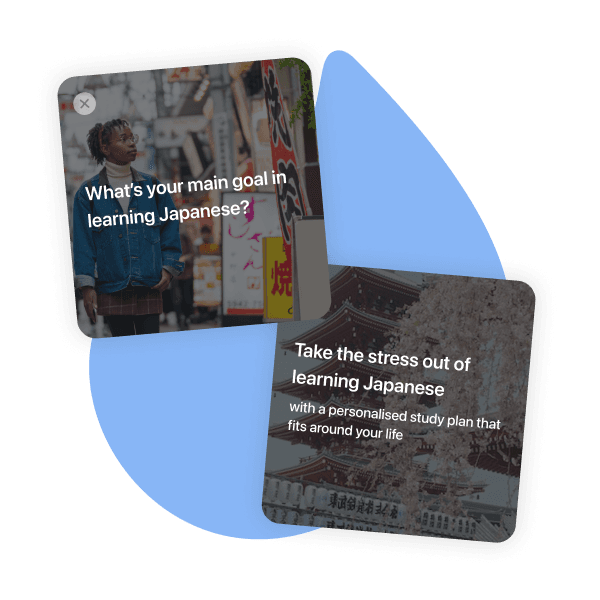
It’s easy to get carried away when learning a new language. You want progress, and you want it now. But being realistic about your goals is important for motivation.
You’re unlikely to achieve unrealistic goals. When you fail to achieve them, you may have negative feelings. These feelings harm your motivation to continue studying.
Instead, set SMART goals. This stands for
S
pecific,M
easurable,A
chievable,R
elevant, andT
ime-bound. Let’s look at an example.Say you’re interested in martial arts. A SMART goal would be to learn ten new kanji related to judo within the next two weeks. This goal is clear and specific. It’s also realistic.
Compare this to a non-SMART goal like becoming fluent in Japanese. This goal is very general. How fluent do you want to be? How long will it take? How will you know when you have achieved this goal? You can see why you’re more likely to achieve a SMART goal.
When you join Busuu Premium, you get access to the built-in Study Plan feature. Choose your Japanese goal, and Study Plan will keep you on track with reminders to study and an estimated date to reach your goal.
3. Build a habit
Mastering a language is all about being consistent. Just as it’s important to set realistic goals, it’s also important to build sustainable habits. It’s much easier to stick with 15 minutes of Japanese study per day compared to three hours on the weekend.
Small, manageable chunks are the way to build a habit. Don’t try to do everything at once. Instead, think about learning Japanese a little at a time and often.
Busuu’s mobile app and bite-sized lessons help you build sustainable habits. Squeeze a study session in no matter where you are or how much time you have.
Seriously, five minutes a day is a fantastic start to building a study habit. It’s easy to stick to, and you’ll see some progress. You can increase the time you spend studying when you want to start taking things more seriously or when you’re sure you can manage the time commitment.
You can learn a language no matter how much time you can commit to studying with Busuu.
4. Learn hiragana and katakana
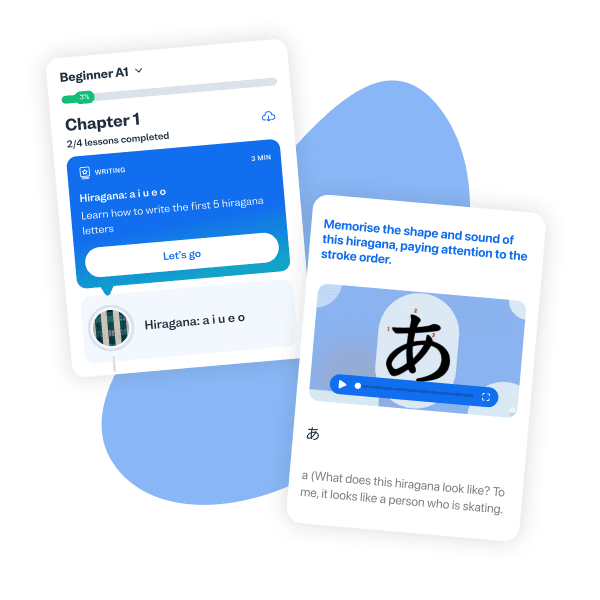
Hiragana is the foundation of Japanese. It looks complicated, but it’s actually quite easy to learn. Hiragana is a phonetic alphabet, so if you can read it, you understand Japanese pronunciation.
Hiragana is used for grammar words, particles, verb forms and other words. Learning this first will give you a great foundation to move on to more complicated Japanese words.
Katakana is less useful than hiragana but is similarly easy to learn. It’s mostly used for foreign loanwords. After mastering hiragana, learning katakana should be relatively straightforward. Check out Busuu’s Hiragana and Katakana courses to help.
5. Learn kanji and vocabulary at the same time
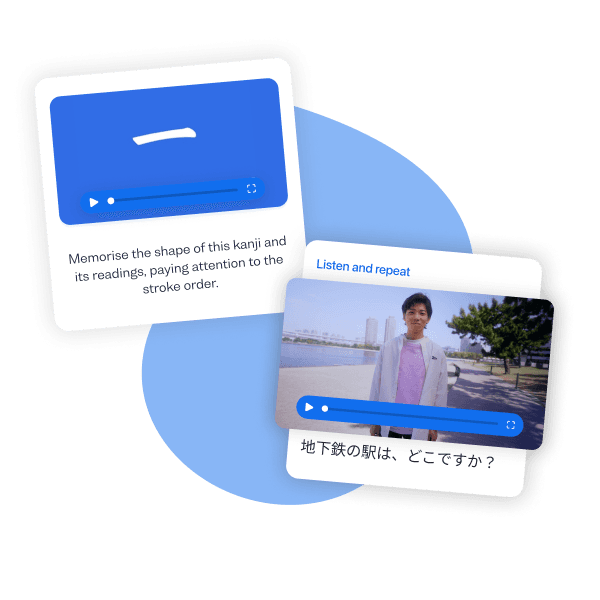
Kanji is hiragana and katakana’s scary older brother. There are thousands of kanji – characters adapted from Chinese – in Japanese. To be fluent in Japanese, you need to know around 2,000 characters.
Luckily, there’s a way to learn kanji efficiently. Don’t learn the characters individually. Learn them as part of words. That way, you learn vocabulary and kanji at the same time.
Don't worry about kanji if you’re at the beginning of your Japanese journey. Focus on hiragana and katakana first. And then learn kanji with grammar and vocabulary in Busuu’s Complete Japanese course.
6. Read manga

Manga, or Japanese comics, are more popular than ever. Reading authentic materials is one of the best ways to learn a language. And manga is one of the most accessible types of authentic Japanese texts.
Until you have a solid understanding of kanji, you need to choose simple manga. Start off with comics for children because the topics will be easy, with the text mostly written using hiragana. As you get more comfortable with kanji, you can increase the difficulty.
Try and choose comics that include furigana. This little hiragana text above kanji shows you how to read the characters.
7. Use spaced repetition
Spaced repetition is a proven way to remember vocabulary and grammar. Simply put, spaced repetition is the strategy of reviewing new knowledge at increasing intervals. For example, after you learn a new word, you might review it after a week, review it again after three weeks, and so on.
Spaced repetition is so effective because it fights against the forgetting curve, which is the natural process of forgetting information when you don’t try to recall it. When you learn Japanese using spaced repetition, you reinforce new knowledge by repeatedly reviewing Japanese words and grammar at spaced-out intervals.
Doing spaced repetition manually with paper is possible but takes a lot of organization. Luckily, Busuu uses adaptive algorithms to build spaced repetition into your learning process. This means that words you already know (which don’t need to be reviewed often) appear less. But words you struggle with pop up more, so you’ll learn them faster.
Here’s how Busuu uses spaced repetition. Busuu’s Vocabulary Trainer remembers the words you come across in your courses. Then it gives you quizzes on these words. The words you forget aren’t gone forever – the algorithm keeps track of them, and you can access them and review them until you’ve learned them.
Busuu Smart Review uses adaptive algorithms to help you learn Japanese words fast. It tracks what you learn, what you remember, and what you forget. It understands your strengths and weaknesses and knows when you need to review to help you remember. Busuu Smart Review gives you personalized language learning.
8. Practice with friends
What’s the point of learning Japanese if you never practice communicating in Japanese? Zero. Unless you live in Japan, finding people to practice with can be tough. Sure, you can try to find a language exchange club or partner. But there’s a better way – the Busuu Community. This online community consists of millions of native speakers and language learners.
When you learn Japanese with Busuu, you can share your spoken and written Japanese and get feedback from native speakers. They’ll point you in the right direction when you’re making mistakes. And they’ll pat you on the back when you’re doing well. You can also help others with their language learning. And they’ll help you. Make friends, get real-life feedback, and make progress in Japanese.
9. Watch Japanese movies and TV shows
What if I told you that you could sit on your sofa, watch interesting shows and movies, and learn Japanese? It’s true – watching TV shows and movies is an effective way to learn a language.
Here's why. When you watch a movie or TV show, you’re getting a ton of language input. Not only do you hear Japanese while seeing the action on the screen, but you also see how native speakers interact, and you get to enjoy some interesting entertainment.
Whether you watch anime or live-action entertainment, using Japanese subtitles (instead of subtitles in your native language) and watching the same shows and movies repeatedly makes it even more effective. For language learning, it pays to watch the same sections over and over again. It’s not as interesting as continuing the story. But it will help you learn.
10. Don’t worry about making mistakes
Learning Japanese isn’t easy. You will make mistakes. But that’s a good thing. Realizing you made a mistake is one way you can learn Japanese. You’ll figure out what is correct and what doesn’t make sense through trial and error. Making mistakes is an important part of the process.
So don’t be down on yourself if you do make mistakes. It’s completely natural. Instead, think of every mistake as an opportunity to learn something new.
Learn Japanese fast
Learning Japanese is a difficult but rewarding challenge. Master Japanese, and you can enjoy manga and anime in their original language. You can find your way around Japan, hopping on and off shinkansens like a pro and communicating with the locals. And, if you ever want to live, work or study in Japan, learning Japanese can make that dream a reality.
Follow the ten tips in the article, and you'll be well on your way to mastering Japanese.
Master Japanese with Busuu
Busuu’s Japanese courses help you make fast progress toward meeting your goals. With bite-sized and motivating lessons, personalized Smart Review of vocabulary and grammar, and feedback from native Japanese speakers in the Busuu Community, you have everything you need to develop your Japanese skills. All on your mobile device.
AUTHOR
Barney Meekin
Newlanguages