I want to learn...
Author:

Emily Duncan
What fast means in language learning
So you want to learn Japanese fast, but what does that really mean?
To learn Japanese efficiently, you’ll need to figure out what your goals are and how much time you can realistically dedicate to reaching them.
In general, due to the huge amount of practice required, you’ll need at least 3–6 months to reach basic conversational fluency in Japanese, but no matter how much time you have, you can learn something, especially if you study smart.
In this guide, you’ll discover the fastest way to learn Japanese with
Japanese language learning resources.
A realistic learning timeline and basic plan.
Tips to track your progress.
The basics of learning Japanese speaking, listening, grammar, reading and writing.
Common learning mistakes.
FAQs about learning Japanese quickly.
Tools and resources: Free and paid options
Want to jump right into learning? Busuu’s award-winning online language learning platform is one of the best resources to learn Japanese fast, and the basic level is always free.

Free resources (Basic plan)
You can learn Japanese online fast and free if you have the time and dedication. Create your own Study Plan, then use resources like Busuu’s basic ad-supported lessons, Busuu blogs, social media, and NHK to make it happen.
Low cost (Premium plan)
Take your studying to the next level with offline learning, no ads, the ability to skip between lessons, and smart study tools to help you review and strengthen your grammar and vocabulary efficiently.
For the Super Studier (Premium Plus)
Progress faster with all the Premium features, plus exclusive content, pronunciation and AI-powered conversation practice, Study Plan reminders, and study streaks to help you stay motivated even on the off days.Understanding speed in Japanese language learning: Setting realistic goals and planning your time
While each learner is different, in general, it takes English speakers 2,200 hours of study to reach C1 (professional working proficiency) on the Common European Framework of Reference for Languages (CEFR) or to pass the N1 (advanced) level of the Japanese Language Proficiency Test (JLPT).
However, beginning language learning always goes faster than advanced language learning, so the average language learning experience breaks down roughly as shown in the table below.
Approximate time to learn Japanese
| CEFR level completed | % of total study hours required (approximate) | Estimated hours studying Japanese per level |
|---|---|---|
| A1 (Beginner) | 8% | 250 |
| A2 (Elementary) | 8% | 250 |
| B1 (Intermediate) | 17% | 535 |
| B2 (Upper intermediate) | 17% | 535 |
| C1 (Advanced) | 20% | 630 |
| C2 (Mastery) | 30% | 950 |
Essentially, if you studied one hour per day, it’d take you around one year and five months to complete the A2 level.
This is why planning and goal-setting is everything when you want to learn Japanese fast.
If you’re hoping to, for example, pass the JLPT N2 level (Pre-advanced – roughly equivalent to B1 or B2 on the CEFR) in two years, you’re looking at studying either in a language school in Japan or at a similar level of intensity.
If, on the other hand, you’re looking to simply learn as much as you can before a trip, you can study in 15- to 30-minute bursts a few times a day and dedicate a few extra hours to studying each weekend. You’ll understand enough Japanese to navigate basic daily interactions in a few months.
Either way, reaching your Japanese language goals quickly is doable. It just needs a little effort!
Pro Tip: Traveling soon and want to focus on just the Japanese you need without all the extra chit-chat? Skip straight to the Japanese for Travel course on Busuu – it’s free and you can start right now!
Core roadmap to quick results: 3- to 6-month plan
Now that you understand the context, let’s talk about how to learn Japanese quickly. Start with a high-level, month-by-month roadmap like this one to reach your goals.
For the sake of building a sample plan, let’s say you want to complete the A2 level of Japanese before a trip in six months. That would be an ambitious but reachable goal, if you can dedicate roughly 80 hours per month (20 hours per week) to studying.
Months 1–3: Mastering the basics
By the end of month three, you’ll want to have completed A1, since A2 should take around an equal amount of time. On Busuu, the A1 level has 31 chapters.
> Month 1
Complete 10 chapters of lessons on Busuu.
Get practice listening by watching Japanese media.
Review Japanese loan words, abbreviations and acronyms to build your vocabulary quickly.
Focus on learning Japanese pronunciation – make sure you’re speaking Japanese out loud from day one.
> Month 2
Start tackling basic kanji.
Complete 11 chapters of lessons on Busuu.
Find opportunities to practice basic, structured conversations.
Build confidence by using Japanese on social media and through support and feedback from the Busuu Community.
> Month 3
Set a goal to have learned 100 kanji by the end of the month.
Complete 10 chapters of lessons on Busuu.
Use shadowing and repeated viewing to build your Japanese listening and pronunciation skills with Japanese media.
Be brave and interact with Japanese speakers through online language learning communities, language classes, in-person cultural events or study buddy programs and groups.
Months 4–6: Building fluency
As you get further along, there’s a little less material, but it’s more complex. On Busuu, the A2 level has 22 chapters.
> Month 4
Set a goal to have learned 175 kanji by the end of the month.
Complete seven chapters of lessons on Busuu.
Try watching Japanese children’s television or reality TV with and without subtitles.
Work through one simple text, like an NHK News Web Easy article or a children’s book.
Practice writing hiragana and katakana by hand.
> Month 5
Set a goal to have learned 235 kanji by the end of the month.
Complete eight chapters of lessons on Busuu.
Attend a Japanese language event or interact in Japanese on social media.
Try making a phone call in Japanese as you prepare for your trip.
Continue reading simple texts and watching Japanese media to build reading and listening comprehension, taking note of new words and phrases.
Practice writing kanji by hand.
> Month 6
Set a goal to have learned 300 kanji by the end of the month.
Complete seven chapters of lessons on Busuu.
Find something that excites you, like a Japanese restaurant or listening to city pop.
Review skills and vocabulary you’ll need for your trip, focusing on phrases for travel, dining out, shopping and other key interests.
Let it go and have fun! You learn a language to communicate with others – it’s okay if you make mistakes, just focus on connecting and doing your best.
Progress tracking: How to measure speed of learning
At Busuu, we make it easy to keep track of where you are in your learning journey by using the CEFR levels. Each level is divided into chapters and lessons, and learners can see what percent of the level they’ve completed.
That said, you can also track your own progress if you choose to learn solo.
Here are a few ideas for how to keep track of your progress in Japanese learning:
Use the core capability statements from the CEFR.
Track progress against the JLPT levels.
Track how many kanji you’ve learned.
Keep records of words and phrases as you learn them.
Break grammar down by level and track your progress.
Take placement tests to see your progress.
Set goals to be able to read, write, listen and speak at a certain level using Japanese books, news, podcasts and media. Regularly check to see how far you can get before you need to translate.
Japanese essentials for faster learning
Ready to dive into learning? Here’s your fast track to Japanese:
Start with hiragana and katakana.
Build confidence with listening and speaking practice.
Start communicating with grammar essentials.
Add kanji as soon as possible to work toward real fluency.
Foundational building blocks: The kana (hiragana and katakana)
If you’re just getting started learning Japanese, make mastering hiragana, and then katakana, a priority. It’ll help you speed up your learning and avoid confusion. Plus, learning to type in Japanese (and adding a Japanese keyboard to your devices) will make learning the language way easier and faster.
Learn hiragana and katakana fast
Hiragana and katakana are easy to learn relatively quickly through rote memorization. To learn them as fast as possible, break them up into groups and use mnemonics to help you remember each character. Learning how to learn new characters (using word association and images or visualizations) is an important skill for learning Japanese quickly.
Here’s how you’ll use mnemonics to learn the Japanese writing systems on Busuu.
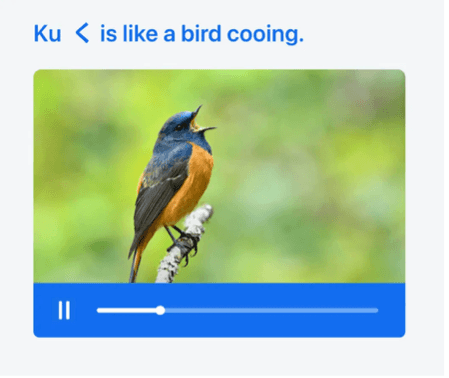
く
ku
‘Ku’ looks like the beak of a bird cooing.
か
ka
‘Ka’ looks like a karate kick.
き
ki
‘Ki’ looks like an old fashioned key.Basic pronunciation and intonation
Learning hiragana and katakana doesn’t just help you start to read in Japanese, it also helps you start to speak Japanese. Hiragana and katakana are syllabaries, meaning each character represents a specific syllable. That means that if you can read the characters, you can start to pronounce the word.
Of course, there are some quirks to Japanese pronunciation, like pitch accent and intonation, but hiragana and katakana are the building blocks you need if you want to learn.
Listening and speaking practice: Immersion that works
If you want to learn Japanese fast at home, the number one thing you need to figure out is how you’ll get practice listening and speaking.
Getting the confidence to speak out loud is one of the biggest challenges for language learners, so building a solid system for regular immersion and practice is important.
Here are a few ideas to help you get started.
Daily micro-conversation drills
Set up a daily check-in to practice short conversations with an AI, friend, tutor or study buddy. Keep a list of topics you’ve learned about to use as prompts, then have 6- to 12-sentence conversations. With an AI conversation partner, tutor or Japanese-speaking friend, you can then ask for feedback and improvement tips.
Some examples of early topics for beginning Japanese learners might be:
Introduce yourself to a new colleague at work.
Greet a fellow student and ask about their background.
Discuss foods you like and anything you don’t eat.
Practice asking for a table and ordering at a restaurant.
Ask a stranger for directions to the nearest subway station.
Listening resources for fast learners
Immerse yourself in Japanese media between study sessions, or build your skills with structured conversation and listening exercises. Here are a few resources you can use to start building your speaking and listening skills:
NHK Easy Japanese lessons
YouTube channels like Yuu-chan Japanese, JapanesePod101, JapanSocietyNYC, Kyota Ko, and Bocchi & Pocchi
Studio Ghibli’s movies for children, like Kiki’s Delivery Service and My Neighbor Totoro (fun to watch and often using fairly basic Japanese)
Busuu’s AI conversation practice, pronunciation practice and community conversation exercises, all with personalized feedback
Grammar essentials for fast communication
Japanese grammar can be a little confusing for new learners, but the basics aren’t too complicated once you get the hang of it.
Here are a few grammar lessons to get you started:
Sentences – Japanese sentences are typically structured subject-object-verb.
Verbs – Verb forms are based on tense, level of politeness, and whether they are positive or negative. Conjugation involves changing the ending on the verb.
Particles – In Japanese, words called particles give context to the words in a sentence. Particles are used in many ways, like to indicate the subject and object of the sentence, to tell direction, to indicate possession, and to make a sentence into a question.
High context – Spoken Japanese uses a lot of context. For example, it’s common to leave out the subject from a sentence when it’s understood from the context.
Built-in politeness – Japanese has something called keigo or honorifics, essentially sets of vocabulary and grammar rules used to indicate different levels of politeness and respect. Along with kanji, this system of polite speech and writing is a big part of why advanced Japanese takes so long to learn.
Reading and writing: How to build confidence and kanji knowledge
The learners who reach Japanese proficiency fastest are typically the ones who have the best system for learning kanji.
Kanji is the third Japanese writing system, and while hiragana and katakana can be learned in a week or two of dedicated study, kanji takes years. You need to learn over 1,000 kanji characters to reach the reading ability of a typical Japanese middle schooler. So if you’re serious about learning Japanese, you’re going to need to buckle down and study.
Exercises & resources for skillbuilding
Here are a few resources to get you started:
Busuu’s dedicated Kanji course
WaniKani kanji learning
Kanji Alive (especially helpful when you want to learn to handwrite kanji)
Study Kanji Quizzer
As you get further along, use graded readers, journaling and summary writing to practice what you learn.
Kanji strategy for speed
If you want to memorize Japanese vocabulary fast, you’ll want to
Use mnemonics to learn new characters.
Track what you’ve learned.
Group kanji by topic, component symbols (called ‘radicals’), or commonalities.
Review what you’ve learned using a spaced repetition system (SRS).
Learn in short, frequent bursts rather than long study sessions
Three common pitfalls and how to avoid them
Here are a few common mistakes that can make it more difficult to learn Japanese fast.
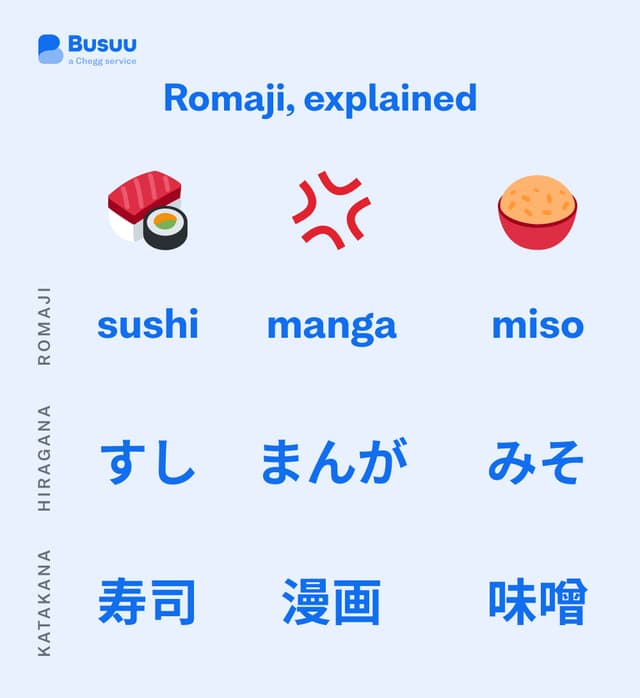
Starting with romaji
There’s a reason we recommend learning hiragana and katakana as soon as possible! Romaji (Japanese spelled out using our alphabet) acts as a crutch and isn’t as useful for learning meaning and pronunciation in Japanese. It might seem easier at first, but in the long run, it’ll hurt your progress.
Burning yourself out with memorization
Learning kanji is important, but rote memorization can tire you out quickly. Start by learning Japanese basics and picking up common kanji in context before you worry about memorizing certain numbers of kanji. Remember to mix up your learning with media and activities to keep things fresh!
Skipping confidence building
If you’ve learned a language before, this might sound familiar – you’ve learned a lot, but when it’s time to actually say something in your second language, you freeze. It’s incredibly common, and the only way to beat it is to put yourself out there, take the leap, and practice speaking.FAQ: Realistic timelines and next steps
Here are a few common questions about learning Japanese when speed is a priority.
What is the fastest someone can learn Japanese?
What’s a realistic learning schedule for reaching Japanese fluency?
What’s the best way to learn Japanese if you want to progress quickly?
Can you learn Japanese fast online?
What can I do to learn Japanese even faster?
AUTHOR
Emily Duncan
Newlanguages