I want to learn...
Author:

Emily Duncan
Why learn Japanese? Benefits and real-world uses
There are tons of great reasons to learn to speak Japanese! A few of the most common reasons include:
Because you’re traveling to Japan
For career development, like a pay bump for knowing two languages or to qualify for a job at a Japanese company
To connect with friends, family or neighbors who speak Japanese
To study in Japan or take college-level Japanese studies
Because you’re a fan of Japanese music, TV, food, film, anime or manga
Learning to speak a new language is a wonderful way to keep your mind sharp. Tackling the challenge of learning Japanese can be entertaining and exciting – and it has real world benefits, from traveling Japan more comfortably to connecting with Japanese-speaking neighbors to enjoying Japanese culture with a deeper understanding.
Practical methods to build fluency
Build your Japanese reading, writing, speaking and listening skills with Busuu’s award-winning language learning platform.
Tackle the Japanese writing systems
Learn to read and use hiragana, katakana and kanji with dedicated, expert-designed courses, featuring proven strategies such as spaced repetition.
Practice speaking from the start
Get over most language learners’ biggest challenge early, with speaking practice built into every chapter and dedicated pronunciation lessons.
Build language skills and confidence
Grow your writing and speaking skills with feedback and encouragement from fluent Japanese speakers in the Busuu Community.Core foundations for speaking Japanese
Fluency in every language breaks down into four basic skills – speaking, listening, reading and writing.
In Japanese, reading and writing can be a unique challenge since the language uses three different writing systems, but getting started with basic Japanese isn’t as tricky as you might expect. While building true fluency in Japanese can take years, learning enough to navigate Japan for a week or two is relatively straightforward.
To learn how to speak Japanese as a beginner, you’ll need to work on
Reading kana
Learning core Japanese vocabulary
Using basic Japanese grammar
Essential Japanese pronunciation rules
Kana mastery: Hiragana and katakana
While kanji takes years to master, with over 1,000 characters to memorize to reach basic literacy, the other two writing systems, hiragana and katakana (sometimes called the kana), are syllabaries – more like an alphabet – and can both be learned in a week or two with dedicated study.
Generally, experts recommend this approach:
Learn hiragana first (the writing system for Japanese words).
Use mnemonics to remember characters.
Review regularly to ensure you retain what you learn.
Learn katakana (the writing system for foreign words) after you have a firm grasp of hiragana. Once you’ve mastered hiragana, katakana will be much simpler, because the sounds are the same and some of the characters look similar to their hiragana counterparts.
What is a syllabary?
It’s like an alphabet, but instead of each letter standing for a single sound, each character represents a syllable, like ‘ah’, ‘ta’ or ‘mo’. Once you get used to it, this type of system is handy, since it gives you a pretty good idea of how new words might be pronounced!
This is also one of the reasons Japanese teachers don’t recommend learning Japanese using romaji any more than you absolutely need to – learning using hiragana and katakana helps you learn to pronounce Japanese and identify loan words sooner.
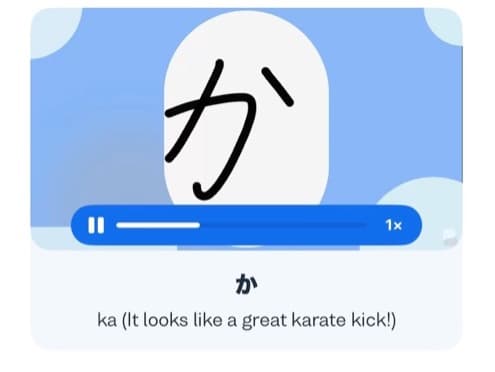
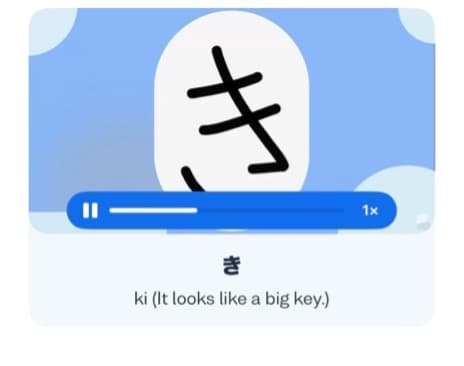
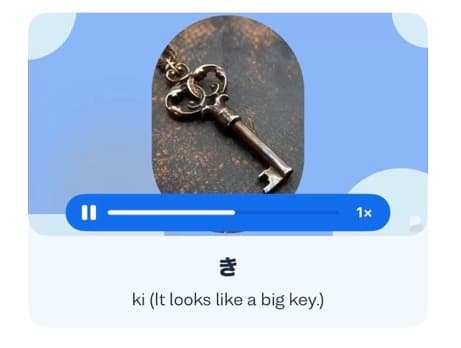
What are mnemonics?
Mnemonics are essentially any device – like an image or phrase – used to remember something. For the Japanese writing systems, we typically use images.

Core vocabulary and phrases
Once you have a grasp of the kana, starting to learn basic Japanese phrases will be much easier. If you’re looking to build practical Japanese skills, start with high-frequency words and phrases like greetings, directions, shopping phrases, travel phrases, and essential verbs and nouns.
The table below has a few words and phrases to kick off your Japanese learning.
Japanese phrases for beginners
| Hiragana or Katakana | Romaji | English |
|---|---|---|
| こんにちは | Konnichiwa | Hello |
| どうもありがとう | Doumo arigatou | Thank you very much |
| もしもし | Moshi moshi | Hi (for phone calls) |
| おねがいします | Onegaishimasu | Please |
| すみません | Sumimasen | Excuse me |
| いただきます | Itadakimasu! | Bon appétit! (A grateful phrase said before eating) |
| はい | Hai | Yes |
| じかん | Jikan | Time |
| でんしゃ | Densha | Train |
| ラメン | Ramen | Ramen |
| カラオケ | Karaoke | Karaoke |
| たべます | Tabemasu | To eat |
| のみます | Nomimasu | To drink |
| おなまえは なんですか。 | O namae wa nani desu ka? | What’s your name? |
| ちかてつのえきはどこですか。 | Chikatetsu no eki wa doko desuka? | Where is the subway station? |
Basic grammar for speaking
Japanese grammar is admittedly a little tricky for English speakers, because there are a few key elements that are different from what you may be used to, even if you already speak another language.
To get started, take a quick look at
While the linked articles will give you a more in-depth understanding of each of these complex topics, this guide will give you the basics of Japanese grammar for beginners.
Japanese sentence structure
In the simplest terms, in English, we use a subject-verb-object sentence structure, as you can see in the example sentence in the table below.
Basic English sentence structure:
| Subject | Verb | Object |
|---|---|---|
| I | eat | pasta. |
In Japanese, however, the most common basic sentence structure is subject-object-verb. The following table shows an example.
Basic Japanese sentence structure:
| Subject | Particle (indicates ‘I’ is the subject) | Object | Particle (indicates ‘pasta’ is the object) | Verb | |
|---|---|---|---|---|---|
| Hiragana | 私 | は | パスタ | を | 食べます |
| Romaji | Watashi | wa | pasuta | o | tabemasu |
| English | I | – | pasta | – | eat |
While it’s a bit of an oversimplification, many tutors will tell you that, when in grammatical doubt, organize your Japanese sentence like Yoda and you’ll probably get pretty close.
Japanese particles
If you look at that sentence above, you’ll notice another new grammatical concept – particles. In Japanese, particles are used to indicate something about the sentence.
The table below shows three of the easiest particles for English learners to master.
Japanese particles
| Hiragana | Romaji | Meaning | In a sentence (Japanese) | In a sentence ( romaji ) | In a sentence (English) |
|---|---|---|---|---|---|
| か | ka | Indicates a question, appears at the end of a sentence like a question mark. | 私か。 | Watashi ka | Me? |
| も | mo | ‘As well’ or ‘too’ | 私も。 | Watashi mo | Me too. |
| の | no | Belonging to, like ’s in English | 私のパスタ。 | Watashi no pasuta. | My pasta. |
Basics of Japanese verb conjugation
There are three kinds of verbs in Japanese:
Ru verbs (also called Ichidan) – verbs where the infinitive ends in -eru or -iru
Irregular verbs – only two! Suru (to do) and kuru (to come)
U verbs (also called Godan) – all other verbs
Japanese verb conjugation, at its most basic, is about changing the ending of a verb to indicate past, present, future, negative and to express politeness. These three types of verbs have slightly different rules, so the distinction is important.
Below is an example of a regular ru verb, miru, to get you started.
Japanese verb miru
| Verb form | Kanji | Hiragana | Romaji | English |
|---|---|---|---|---|
| Infinitive | 見る | みる | miru | to look |
| Affirmative, plain | 見る | みる | miru | looking, will look |
| Affirmative, polite | 見ます | みます | mimasu | looking, will look |
| Past, plain | 見た | みた | mita | looked |
| Past, polite | 見ました | みました | mimashita | looked |
| Negative, plain | 見ない | みない | minai | not looking, don’t look, won’t look |
| Negative, polite | 見ません | みません | mimasen | not looking, don’t look, won’t look |
For the purposes of beginning Japanese learners, focus on the polite forms. These are the forms you’ll use most, since they’re expected in places like hotels and restaurants, and you want to be a good guest!
Pronunciation and accent
Japanese pronunciation is generally straightforward, but there are a few things you should know:
‘R–’ and ‘f–’ sounds are pronounced a little differently.
‘Su’, ‘chi’ and ‘shi’ syllables are frequently dropped, sounding more like ‘s’, ‘ch’ and ‘sh’.
Japanese isn’t tonal like some other Asian languages, but it does have certain words where pitch or intonation is used to convey meaning.
While English speakers tend to put a lot of expression into their spoken language, Japanese speakers tend to use a fairly flat tone and rhythm, so if you want to sound more natural in Japanese, you may need to simply do less.
Memory, words and retention: How language learning works
A data-backed approach makes Busuu a standout among Japanese learning apps. Here are a few of the strategies Busuu’s language experts use to help beginners memorize and retain vocabulary effectively.
> Mnemonics
Given how many kanji you have to learn to read a book or newspaper (over a thousand!), memorization is really important for serious Japanese learning. A 2018 study found that mnemonics do more than help individuals remember information in the short term – they help train the brain to improve memory function.
> Spaced repetition
Research shows that learning over a longer period of time and reviewing at specific, increasing intervals can help you remember more of what you learn and make more long-term memories. This is called spaced repetition. When you learn with Busuu, you’ll use this method automatically, thanks to an adaptive algorithm that personalizes your spaced repetition schedule for improved efficiency and effectiveness.
> Contextual learning
On Busuu, learning is always done in context, with new characters and concepts introduced through useful phrases and memorable exercises. By the time you’re looking to actively start memorizing kanji, you’ll already recognize tons of basic kanji from your lessons.
Reading and writing foundations: Tackling kanji
Ultimately, while you can get along with just the basics, if you really want to learn to speak Japanese, you will also have to learn to read Japanese, including kanji. While it takes time, it is possible! And learning kanji will help you build your vocabulary, grammar and overall comprehension.

Start small
Start with simple, common kanji, like numbers, animals and family, and use mnemonics to help you memorize them. You’ll come across many of these naturally in your lessons and can start to build confidence and memory.
Learn in context
Focus first on learning Japanese holistically – simply make note of new kanji as you are introduced to them until you feel ready. You want to avoid overloading yourself early to ensure new concepts stick.
Build strategically
Once you have a solid Japanese foundation, dedicate more time and focus to building your kanji vocabulary. Use simple texts like NHK News Web Easy and build from there to more complex reading.Going deeper: Immersion, culture and etiquette in Japan
Learning Japanese means learning not just the language, but the culture. Etiquette looks a little different in Japan, and if you want to live in Japan or immerse yourself in Japanese culture, you’ll need to learn more than the words for ‘right’ and ‘left’.
Cultural nuances in Japanese
When you learn Japanese with Busuu, you’ll learn the standard polite forms of most regular verbs and phrases. In fact, the plain versions may be seen as very familiar or even rude. But that’s not all – Japanese can get much more polite.
There’s a whole other layer of language in Japanese called keigo, or
expressing different levels of politeness. Different levels of politeness are used in Japanese business, among diplomats, and with royalty, so if you want to work in a Japanese office, you’ll need to spend some serious time learning keigo.
Etiquette in Japan
As with any culture, there are many, many small, often unwritten rules that go into behaving well in Japanese society.
Here are a few examples that often get Western tourists in trouble:
Be quiet on the train.
Blowing your nose in public is considered rude.
Take off your shoes when visiting someone’s home and use guest slippers.
Avoid showing affection, for example kissing, in public.
Use the back end of your chopsticks or use dedicated serving chopsticks when sharing dishes.
FAQ
Here are a few common questions learners often ask about starting to speak Japanese.
How long does it take to learn to speak Japanese fluently?
Is Japanese hard to learn?
Is learning Japanese worth it?
What’s the best way to start learning Japanese?
7-day starter roadmap to begin speaking
Want to jumpstart your Japanese learning? Here’s a 7-day plan to get you started.
Day 1: Gather resources and sign up for language lessons. Take your first Japanese lesson and learn some basics. Make sure you try speaking out loud! Get started and get excited!
Day 2: Start learning hiragana. Read the whole chart, then start by using mnemonics to memorize the vowels.
Day 3: Dedicate some time to your language learning, and dive in a little deeper with essential phrases, greetings and introductions. Try a practice conversation. Work on memorizing two more lines of the hiragana chart.
Day 4: Mix things up by watching some Japanese language learning videos on YouTube, listening to Japanese music, or finding Japanese learning resources on social media. Practice your hiragana and keep building.
Day 5: Learn to talk a little bit about yourself and work on basic words for asking and answering questions.
Day 6: Try memorizing the rest of the hiragana.
Day 7: Take some time to review everything you’ve learned. Watch a Japanese movie or TV show and see if you can pick out any familiar words!
AUTHOR
Emily Duncan
Newlanguages