I want to learn...
What you’ll learn:
You’ll learn how counting works from 1 to 100, so you can order items and say the time in everyday situations.
You’ll see the regular pattern from 21 to 69 and the math-style forms after 70, so you can understand prices in shops.
You’ll get a clear idea of ordinal forms and how dates are said, so you can write an event date on an invitation
When you’re learning French, numbers are one of the basics you simply have to master.
After all, how else will you order 6 croissants, or tell your new boss that you’ll be there at 10 o’clock?
In this article, we’ll teach you how to say the numbers from 1 to 100 in French.
One quick note before we start: while we’ve shared a loose pronunciation guide for some of the French numbers, the reality is that the French language uses different sounds from English, so a written guideline is just that. Join Busuu’s online learning community to practice listening and speaking, numbers included, with the help of native French speakers!
Allons-y!
Learn to count French numbers 1 to 100
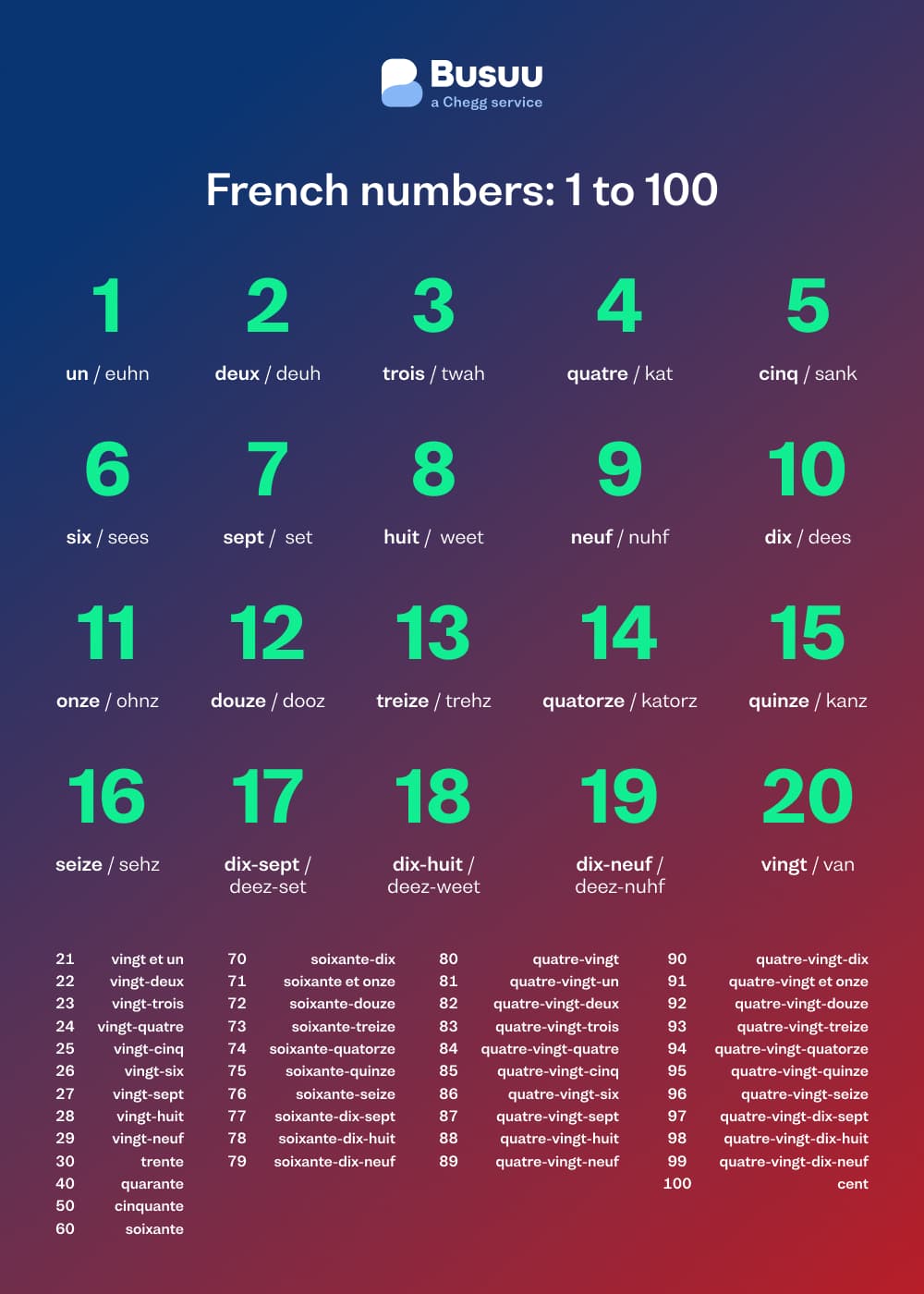
Rather than try to tackle all 100 numbers at once, let’s start with something simple: the French numbers 1 to 20.
French numbers 1-20
| Numeral | In French | Pronunciation |
|---|---|---|
| 0 | zéro | zay-ro |
| 1 | un | euhn |
| 2 | deux | deuh |
| 3 | trois | twah |
| 4 | quatre | kat |
| 5 | cinq | sank |
| 6 | six | sees |
| 7 | sept | set |
| 8 | huit | weet |
| 9 | neuf | nuhf |
| 10 | dix | dees |
| 11 | onze | ohnz |
| 12 | douze | dooz |
| 13 | treize | trehz |
| 14 | quatorze | katorz |
| 15 | quinze | kanz |
| 16 | seize | sehz |
| 17 | dix-sept | deez-set |
| 18 | dix-huit | deez-weet |
| 19 | dix-neuf | deez-nuhf |
| 20 | vingt | van |
You’ll notice that 11 to 16 in French don’t quite follow a regular pattern just yet, like how we say eleven and twelve in English instead of anything more predictable. However, once you hit 17, things start to follow a pattern. Notice that 17, 18, and 19 are the French for 10-7, 10-8, and 10-9.
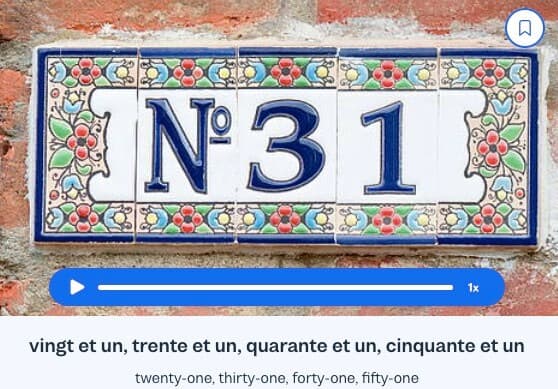
The most unique feature of French counting for the next section is that, unlike English numbers and numbers in many other Romance languages, you add an et – French for ‘and’ – in every number ending in 1.
Let’s go up to 69 to see how it works.
French numbers 21-69
| Numeral | In French |
|---|---|
| 21 | vingt et un |
| 22 | vingt-deux |
| 23 | vingt-trois |
| 24 | vingt-quatre |
| 25 | vingt-cinq |
| 26 | vingt-six |
| 27 | vingt-sept |
| 28 | vingt-huit |
| 29 | vingt-neuf |
| 30 | trente |
| 31 | trente et un |
| 32 | trente-deux |
| 33 | trente-trois |
| 34 | trente-quatre |
| 35 | trente-cinq |
| 36 | trente-six |
| 37 | trente-sept |
| 38 | trente-huit |
| 39 | trente-neuf |
| 40 | quarante |
| 41 | quarante et un |
| 42 | quarante-deux |
| 43 | quarante-trois |
| 44 | quarante-quatre |
| 45 | quarante-cinq |
| 46 | quarante-six |
| 47 | quarante-sept |
| 48 | quarante-huit |
| 49 | quarante-neuf |
| 50 | cinquante |
| 51 | cinquante et un |
| 52 | cinquante-deux |
| 53 | cinquante-trois |
| 54 | cinquante-quatre |
| 55 | cinquante-cinq |
| 56 | cinquante-six |
| 57 | cinquante-sept |
| 58 | cinquante-huit |
| 59 | cinquante-neuf |
| 60 | soixante |
| 61 | soixante et un |
| 62 | soixante-deux |
| 63 | soixante-trois |
| 64 | soixante-quatre |
| 65 | soixante-cinq |
| 66 | soixante-six |
| 67 | soixante-sept |
| 68 | soixante-huit |
| 69 | soixante-neuf |
Phew! Now you can count from 1 to 69 in French. But, why take a pause here?
Well, as we go into this final stretch, you’ll notice something really interesting about French numbers – things get in some ways more complicated, and in other ways less. From here on out, all of the numbers should look familiar.
See, counting to 100 in French includes doing a little math! Fortunately, once you have it down, it makes remembering the names of the numbers fairly straightforward. Check it out.
French numbers 70 to 100
| Numeral | In French |
|---|---|
| 70 | soixante-dix |
| 71 | soixante et onze |
| 72 | soixante-douze |
| 73 | soixante-treize |
| 74 | soixante-quatorze |
| 75 | soixante-quinze |
| 76 | soixante-seize |
| 77 | soixante-dix-sept |
| 78 | soixante-dix-huit |
| 79 | soixante-dix-neuf |
| 80 | quatre-vingt |
| 81 | quatre-vingt-un |
| 82 | quatre-vingt-deux |
| 83 | quatre-vingt-trois |
| 84 | quatre-vingt-quatre |
| 85 | quatre-vingt-cinq |
| 86 | quatre-vingt-six |
| 87 | quatre-vingt-sept |
| 88 | quatre-vingt-huit |
| 89 | quatre-vingt-neuf |
| 90 | quatre-vingt-dix |
| 91 | quatre-vingt-onze |
| 92 | quatre-vingt-douze |
| 93 | quatre-vingt-treize |
| 94 | quatre-vingt-quatorze |
| 95 | quatre-vingt-quinze |
| 96 | quatre-vingt-seize |
| 97 | quatre-vingt-dix-sept |
| 98 | quatre-vingt-dix-huit |
| 99 | quatre-vingt-dix-neuf |
| 100 | cent |
So, as you can see, 70 becomes soixante-dix, 60-10, 71 is soixante-et-onze, 60-and-11, and so on up to 80.
80 is quatre-vingt, meaning 4-20, which, of course, 80 is 4 20s. 81 is quatre-vingt-un (note, no et for 81!), 90 is quatre-vingt-dix, 4-20-10, and 98 is quatre-vingt-dix-huit – 4-20-10-8. Once you can crack the math side of French counting, the number tells you what it is in simple terms!
Struggling to remember? Try counting something in your house, in your next workout, or in your daily routine en français.
But wait! What about French ordinal numbers?
Ordinal numbers, like first, second, and third, can be awfully handy. And the good news is, they’re fairly simple to figure out in French.
Other than first, which is premier (m) or première (f), ordinal numbers use the cardinal number (like deux, trois, quatre) plus the suffix –ième, and do not change based on gender. For numbers that end in an e, we drop the e. For cinq and neuf there’s a small change to cinquième and neuvième, and everything else is predictable!
Worth noting: For dates in French, we use premier for the 1st, but otherwise the cardinal numbers only, so you would say deux (2) août, not deuxième (2e) août for August 2nd.
Let’s take a look.
Ordinal number chart
| Cardinal | Ordinal | English abbreviation | French abbreviation |
|---|---|---|---|
| un | premier, première | 1st | 1er, 1re |
| deux | deuxième | 2nd | 2e |
| trois | troisième | 3rd | 3e |
| quatre | quatrième | 4th | 4e |
| cinq | cinquième | 5th | 5e |
| six | sixième | 6th | 6e |
| sept | septième | 7th | 7e |
| huit | huitième | 8th | 8e |
| neuf | neuvième | 9th | 9e |
| dix | dixième | 10th | 10e |
| onze | onzième | 11th | 11e |
| vingt-trois | vingt-troisième | 23rd | 23e |
| cinquante | cinquantième | 50th | 50e |
| cent | centième | 100th | 100e |
And now you know your French numbers
And there you have it! French numbers, 1 to 100, covered.
That wasn’t so hard, right? When you set your mind to it, learning to count is as simple as un, deux, trois – that’s 1, 2, 3 in French, as you now know.
Newlanguages