I want to learn...
Learning how to conjugate fare is one of the most important steps in your Italian journey, because it’s a verb you will find everywhere.Fare’s closest translation in English is “to do” or “to make” but Italians say this verb when talking about anything from sports and hobbies to everyday actions like having breakfast.
Discover how to conjugate fare in the most common tenses and moods, as well as some common idiomatic phrases that rely on fare.
What exactly does fare mean?
Before we get to the different tenses and moods of fare, you should understand that it’s not easily translated into English. Fare can be used to mean:
To do
To make
To create
To prepare
To commit/execute
To act as
Italians use fare for current actions someone is taking or has taken, but also to talk about jobs or hobbies. It’s also the verb to use when talking about the weather.
Unfortunately, fare is very irregular, and it won’t follow the normal conjugation rules of -are verbs that you’ve learned in our guide to conjugating Italian verbs. Instead, the only thing to do is memorize each conjugation by heart.

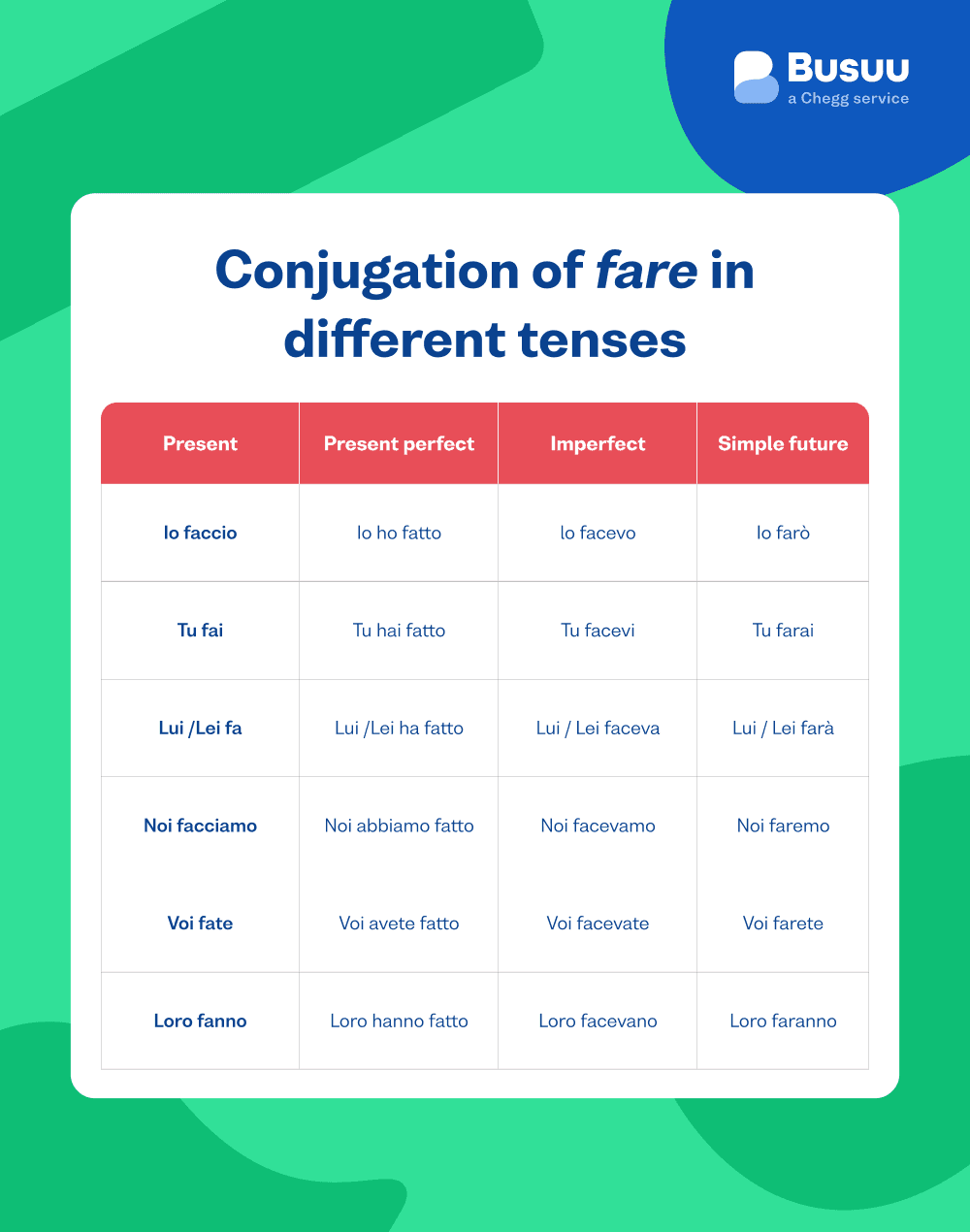
Present tense –indicativo presente
Let’s start with the present tenses with all conjugated verbs, it will have unique forms based on the pronoun – i.e. the person doing the action.
Here’s a chart that shows how fare conjugates to each of the six pronouns. The conjugated form of fare is in bold.
How to conjugate fare in the present tense
| Italian pronoun + fare verb | English translation |
|---|---|
| Io faccio | I do |
| Tu fai | You do |
| Lui /Lei fa | He / She does |
| Noi facciamo | We do |
| Voi fate | You (plural) do |
| Loro fanno | They do |
Because every verb conjugates to the pronoun, Italians can leave out the pronoun so long as it’s understood who is being talked about. For example, often, Italians will say “Io faccio colazione” (I’m having breakfast) without io, becoming“faccio colazione”.
Now that we’ve seen the present tense forms, let’s take a look at some examples:
Che lavoro fa? (What does he/she do/what is his/her job?)
Che fai? (What are you doing?)
Faccio la spesa oggi. (I’m going grocery shopping today.)
Fanno una passeggiata. (They’re taking a walk.)
Fa freddo. (It’s cold.)
Pro-tip: Don’t confuse the third person present tense form of fare (fa) with the adverb of time fa (ago). Italians know which one you’re talking about based on context. For example: Sono stato in Italia quattro anni fa. (I went to Italy four years ago.)
We use this verb to talk about sports and free time activities. Here are some examples:
Fare yoga – to do yoga
Fare palestra – to go to the gym
Fare jogging – to go jogging
Fare nuoto – to go swimming
Fare danza – to take dance classes
Present perfect –passato prossimo
Italian has more than one past tense, and the first we’ll learn for fare is passato prossimo.
Right now, all you need to know is that this tense indicates the action has already begun and completed by the time of speaking. It’s also a compound tense, meaning it is constructed of two verbs: the verb avere the past participle of fare, which is fatto.
To see examples, take a look at the chart below:
How to conjugate fare in the present perfect
| Italian pronoun + fare verb | English translation |
|---|---|
| Io ho fatto | I have done |
| Tu hai fatto | You have done |
| Lui /Lei ha fatto | He / She has done |
| Noi abbiamo fatto | We have done |
| Voi avete fatto | You (plural) have done |
| Loro hanno fatto | They have done |
Here are sample sentences of
Ho fatto i miei compiti. (I’ve done my homework.)
Hai fatto una domanda? (Did you ask a question?)
Abbiamo fatto un viaggio a Parigi. (We’ve taken a trip to Paris.)
Hanno fatto la fila per ore! (They stood in line for hours!)
Imperfect –imperfetto
The imperfect tense is the other Italian past tense that you will most often hear in conversations. This tense indicates an action that continued for a long or indefinite amount of time in the past.
Unlikepassato prossimo, which is generally used for an action that happened once,imperfettois used for past actions that happened often or continuously.
How to conjugate fare in the imperfect tense
| Italian pronoun + fare verb | English translation |
|---|---|
| lo facevo | I did / I was doing |
| Tu facevi | You did / You were doing |
| Lui / Lei faceva | He / She did / He / She was doing |
| Noi facevamo | We did / We were doing |
| Voi facevate | You (plural) did / You (plural) were doing |
| Loro facevano | They did / They were doing |
It’s also commonly placed after the marker mentre (while). Take a look below:
Da piccola, facevo sempre castelli in aria. (When I was little, I was always daydreaming.)
Faceva del suo meglio. (He/she was doing his/her best.)
Non facevate mai attenzione. (You all never paid attention.)
Facevano sempre una frittata per gli ospiti. (They always made a frittata for guests.)
Mentre facevamo un giro, il cane ha distrutto un cuscino. (While we were taking a stroll, the dog destroyed a pillow.)

Remote past –passato remoto
The Italian tense passato remoto indicates an action that happened a long time ago. Its use in everyday conversation has regional variations. For example, it is used on a daily basis throughout southern Italy and Tuscany. It is also commonly found in literature or history books.
See below for a table demonstrating the remote past:
How to conjugate fare in the remote past
| Italian pronoun + fare verb | English translation |
|---|---|
| Io feci | I did |
| Tu facesti | You did |
| Lui / Lei fece | He / She did |
| Noi facemmo | We did |
| Voi faceste | You (plural) did |
| Loro fecero | They did |
Examples of passato remoto:
Allora facemmo amicizia facilmente. (We made friends easily back then.)
Il Tea Party di Boston fece arrabbiare la monarchia britannica. (The Boston Tea Party angered the British monarchy.)
Simple future –futuro semplice
The simple future tense or futuro semplice indicates an action that hasn’t happened yet. In English, this looks like “will” or “going to”. In Italian, the future tense can also express doubt or speculation.
How to conjugatefarein the simple future tense
| Italian pronoun + fare verb | English translation |
|---|---|
| Io farò | I will do |
| Tu farai | You will do |
| Lui /Lei farà | He / She will do |
| Noi faremo | We will do |
| Voi farete | You (plural) will do |
| Loro faranno | They will do |
Let’s see how this tense looks in action:
Farò i compiti domani. (I’ll do my homework tomorrow.)
Farai la pasta oggi? (Will you make the pasta today?)
L’anno prossimo faranno ginnastica insieme. (They’ll do gymnastics together next year.)
Pro-tip: Many Italians skip the future tense in favor of the present tense – similar to how we might say “Are you making the cake today?” instead of “Will you make the cake today?”
Imperative –imperativo
Imperativo is the Italian tense for giving instructions, orders or advice. Imperative verbs are usually employed without the subject pronoun.
How to conjugatefare in the imperative mood
| Fare verb | English translation |
|---|---|
| Fai/fa’ | Do! |
| Facciamo(lo) | Let’s do (it)! |
| Fate | Do! |
The most common pronouns to hear this imperative mood with are the second person pronouns, tu and voi.
Note: If you are making a negative command, for the 2nd person singular you will use the infinitive (base form of the verb), which in this case is fare.
Here’s examples of
Fate attenzione! (Pay attention!)
Fa’ silenzio! (Be quiet!)
Non fare tardi! (Don’t be late!)
Gerund –gerundio
Our last conjugation of fare is the gerund form. The gerundio expresses an action that is happening or continuing at the moment of speaking, or an action that is having consequences on another action. In English, this looks like “doing” or “making”.
Here’s how the gerund of
How to conjugatefarein the gerund form
| Present | English translation | Past | English translation |
|---|---|---|---|
| Facendo | doing | Avendo fatto | having done |
Examples of
Sta facendo la presentazione da solo. (He’s making the presentation alone.)
Avendo fatto un lungo viaggio, dimenticò com’era sentirsi a casa. (Having gone on a long trip, he forgot what it was like to be home.)
You’ll find the verb fare everywhere in Italian expressions, from everyday actions, sports, weather to idioms and more! Conjugating fare can take a little extra work because it’s irregular, but once you learn it, you can easily use it in Italian conversations.
With Busuu, learning how to conjugate Italian verbs has never been simpler. Our goal is to help Italian language learners organically practice Italian with our online courses.
Newlanguages