I want to learn...
There are two types of verbs in French - regular and irregular verbs. Regular verbs follow a set, regular pattern. The patterns exist not only in the present tense but also in other tenses where the verb is used. Irregular verbs, on the other hand, do not follow a pattern. Their final letters do not determine what conjugated endings they’ll receive.
In this article, we will focus on French irregular verbs. These verbs need to be memorized because even though there are far more regular verbs than irregular ones, irregular verbs are some of the most important and common verbs in the French language.
Let’s dive into the world of irregular verbs and find some ways to learn them.

The most used irregular verbs in French
Did you know that there are four irregular French verbs that are used in daily life? These common irregular verbs are:
être - to be
aller - to go
avoir - to have
faire - to make, to do
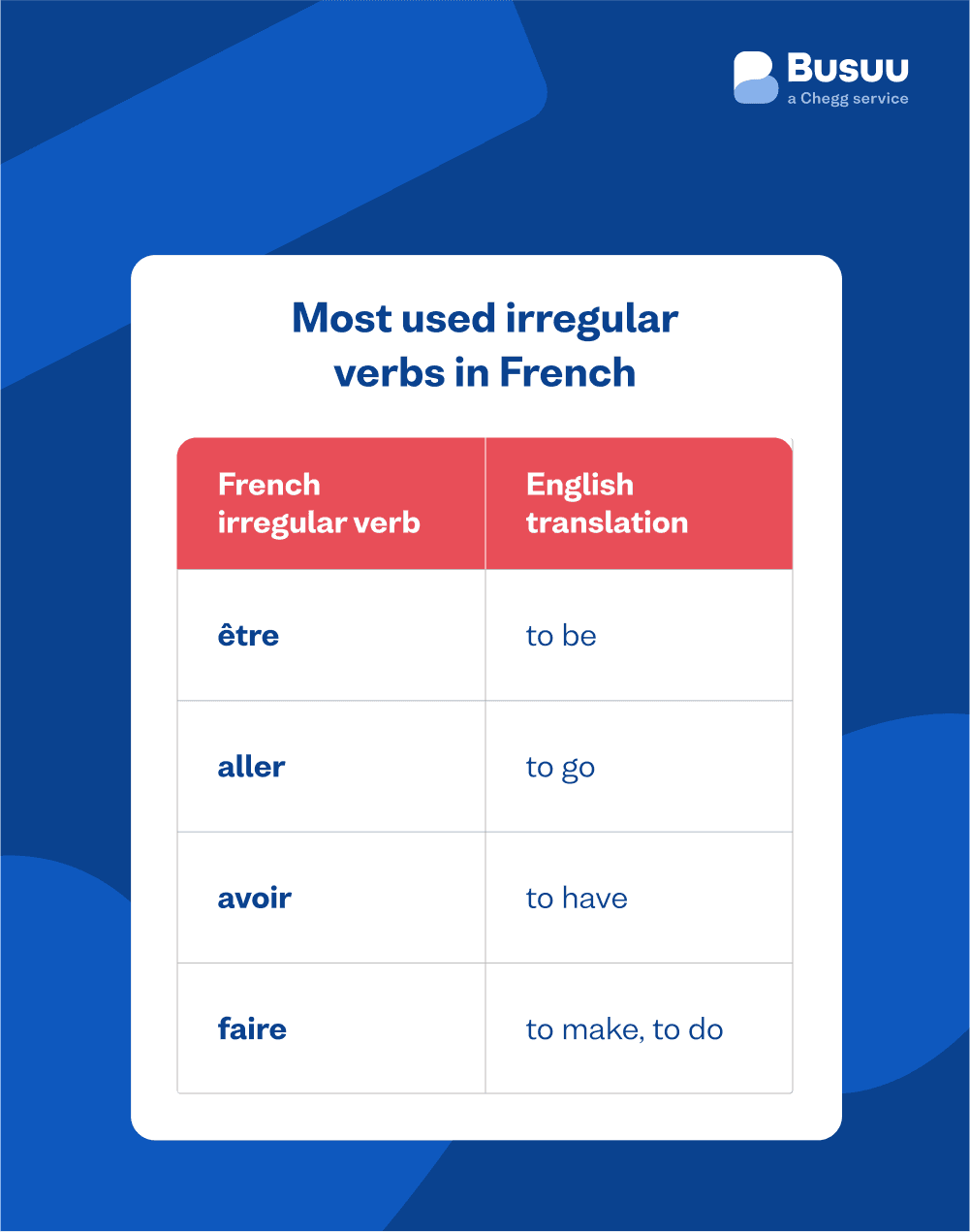
Let's learn how these verbs are conjugated.
être – to be
| Singular | Plural |
|---|---|
| Tu es | Vous êtes |
| Je suis | Nous sommes |
| il est | ils sont |
| Elle est | Elles sont |
aller – to go
| Singular | Plural |
|---|---|
| Je vais | Nous allons |
| Tu vas | Vous allez |
| il va | ils vont |
| Elle va | Elles vont |
avoir – to have
| Singular | Plural |
|---|---|
| J’ai | Nous avons |
| Tu as | Vous avez |
| il a | Ils ont |
| Elle a | Elles ont |
faire – to make, to do
| Singular | Plural |
|---|---|
| Je fais | Nous faisons |
| Tu fais | Vous faites |
| il fait | ils font |
| Elle fait | Elles font |
Let's learn how to conjugate irregular French verbs that follow certain patterns
Some irregular verbs follow patterns, so once you know these patterns, it’s easier to identify and conjugate irregular verbs.
Prendre
Verbs ending in –prendre are all conjugated like prendre:
Prendre - to take
| Singular | Plural |
|---|---|
| Je prends | Nous prenons |
| Tu prends | Vous prenez |
| Il prend | Ils prennent |
| Elle prend | Elles prennent |
Similar verbs that are conjugated like Prendre
apprendre – to learn
comprendre – to understand
entreprendre – to undertake
méprendre – to mistake
prendre – to take
reprendre – to retake, to take again
surprendre – to surprise
Mettre
Mettre and the verbs ending in –mettre all follow the same pattern of conjugation.
Mettre - to put
| Singular | Plural |
|---|---|
| Je mets | Nous mettons |
| Tu mets | Vous mettez |
| Il met | Ils mettent |
| Elle met | Elles mettent |
Similar verbs that are conjugated like Mettre
admettre – to admit
commettre – to commit
compromettre – to compromise
mettre – to put, to place
permettre – to permit
promettre – to promise
remettre – to turn in work, to postpone
soumettre – to submit
transmettre – to transmit
Venir
Venir and the verbs that end with -nir have their own pattern of conjugation, and in this case, the verb undergoes a stem change.
The stem vien is used withje, tu, il, elle; the stem ven is used with nous and vous; the stemvien is used with ils and elles respectively.
Venir - to come
| Singular | Plural |
|---|---|
| Je viens | Nous venons |
| Tu viens | Vous venez |
| Il vient | Ils viennent |
| Elle vient | Elles viennent |
Similar verbs that are conjugated like venir-
abstenir – to refrain, to abstain from
advenir – to happen
appartenir – to belong to
circonvenir – to circumvent
contenir – to contain
convenir – to suit, to be suitable
détenir – to detain
devenir – to become
entretenir – to look after, to support
intervenir – to intervene
maintenir – to maintain
obtenir – to obtain
parvenir – to reach, to achieve
prévenir – to warn
retenir – to retain
soutenir – to support
souvenir – to remember
subvenir – to provide for
survenir – to occur, to take place
tenir – to hold, to keep
venir – to come
Manger
Verbs ending in -ger have a spelling change in the nous form of the verb.
An extra -e is added to keep the -g sound soft.
Manger - to eat
| Singular | Plural |
|---|---|
| Je mange | Nous mangeons |
| Tu manges | Vous mangez |
| Il mange | Ils mangent |
| Elle mange | Elles mangent |
Similar verbs that are conjugated like Manger-
bouger – to move
changer – to change
corriger – to correct
décourager – to discourage
déménager – to move
déranger – to disturb
diriger – to direct
encourager – to encourage
engager – to bind
exiger – to demand
juger – to judge
loger – to lodge
manger – to eat
mélanger – to mix
nager – to swim
obliger – to oblige
partager – to share
rédiger – to write
voyager – to travel
Lancer
Verbs like lancer that end in -cer also have a spelling change in the nous form.
The -c is changed to a -ç to maintain a soft -c sound.
Lancer - to throw
| Singular | Plural |
|---|---|
| Je lance | Nous lançons |
| Tu lances | Vous lancez |
| Il lance | Ils lancent |
| Elle lance | Elles lancent |
Similar verbs that are conjugated like Lancer-
annoncer – to announce
avancer – to advance
commencer – to commence
dénoncer – to denounce
divorcer – to divorce
effacer – to erase
lancer – to throw
menacer – to threaten
placer – to put
prononcer – to pronounce
remplacer – to replace
renoncer – to renounce
Payer
Verbs ending in -yer change the -y to an -i in the je, tu, il, elle, ils and elles forms.
Payer - to pay
| Singular | Plural |
|---|---|
| Je paie | Nous payons |
| Tu paies | Vous payez |
| Il paie | Ils paient |
| Elle paie | Elles paient |
Similar verbs that are conjugated like payer-
aboyer – to bark
balayer – to sweep
effrayer – to frighten
s’ennuyer – to be bored
envoyer – to send
essayer – to try
essuyer – to wipe
nettoyer – to clean
payer – to pay
renvoyer – to send back, to fire
Acheter
Some verbs, like acheter, change the -e in the root to -è in the je, tu, il, elle, ils and elles forms.
Acheter - to buy
| Singular | Plural |
|---|---|
| J’ achète | Nous achetons |
| Tu achètes | Vous achetez |
| Il achète | Ils achètent |
| Elle achète | Elles achètent |
Similar verbs that are conjugated like acheter-
acheter – to buy
amener – to bring
enlever – to take off
espérer – to hope
geler – to freeze
se lever – to get up
posséder – to own
préférer – to prefer
se promener – to take a stroll
répéter – to repeat
suggérer – to suggest
Appeler
Some French verbs that end in -eler and -eter double the l or t in all except nous and vous in the present tense.
Example: appeler –> appel/appell -er (to call)
Appeler - to call
| Singular | Plural |
|---|---|
| J’ appelle | Nous appelons |
| Tu appelles | Vous appelez |
| Il appelle | Ils appellent |
| Elle appelle | Elles appellent |
Similar verbs that are conjugated like appeler-
appeler – to call
épeler – to spell out
étinceler – to sparkle
feuilleter – to leaf through a book
jeter – to jump
renouveler – to renew

How to conjugate irregular French verbs that don’t follow a specific pattern
Most irregular French verbs don’t follow any specific pattern and therefore, have to be memorized.
So, let’s learn a few of them.
dire – to say, to tell
| Singular | Plural |
|---|---|
| Je dis | Nous disons |
| Tu dis | Vous dites |
| il dit | Ils disent |
| Elle dit | Elles disent |
lire - to read
| Singular | Plural |
|---|---|
| Je lis | Nous lisons |
| Tu lis | Vous lisez |
| il lit | Ils lisent |
| Elle lit | Elles lisent |
pouvoir – to be able to do
| Singular | Plural |
|---|---|
| Je peux | Nous pouvons |
| Tu peux | Vous pouvez |
| Il peut | Ils peuvent |
| Elle peut | Elles peuvent |
savoir – to know, to know how to
| Singular | Plural |
|---|---|
| Je sais | Nous savons |
| Tu sais | Vous savez |
| Il sait | Ils savent |
| Elle sait | Elles savent |
voir – to see
| Singular | Plural |
|---|---|
| Je vois | Nous voyons |
| Tu vois | Vous voyez |
| Il voit | Ils voient |
| Elle voit | Elles voient |
vouloir – to want
| Singular | Plural |
|---|---|
| Je veux | Nous voulons |
| Tu veux | Vous voulez |
| Il veut | Ils veulent |
| Elle veut | Elles veulent |
Newlanguages