I want to learn...
Adjectives, as you probably already know, are used to describe traits, qualities, or quantities of nouns, either independently or when compared to something else. French adjectives are used in the exact same way with just two major differences in the usage between French and English.
Adjectives in French
In French, it is important to note the two rules that make the use of adjectives different than in English:
Many French words have genders, so adjectives need to agree with the gender of the noun. In addition to gender, they also need to agree with the quantity of the noun.
Adjectives generally come after the noun unless they are special adjectives used for beauty, age, number, goodness, or size.

Masculine and feminine adjectives
If you know some French, you probably know that many adjectives, objects, and nouns are gendered.
French adjectives have to agree with the nouns that they describe.
Masculine and feminine adjectives with their meanings
| Masculine Singular | Meaning | Feminine Singular | Meaning |
|---|---|---|---|
| un homme grand un grand homme | a tall man a great man | une belle femme | a beautiful woman |
| un petit chien | a small dog | une petite chienne | a small dog |
| un garçon actif | an active boy | une fille active | an active girl |
So you have to use a masculine singular adjective with a masculine singular noun and vice-versa, and a feminine plural adjective with a feminine plural noun, and vice-versa.
Now that you've seen them, we'll discuss their forms.
4 forms of French adjectives
1. Masculine singular
The masculine form of an adjective is the root/base form of the word.
2. Feminine singular
To write out an adjective as feminine, you just have to add an “e” at the end of the word.
3. Masculine plural
To make a masculine singular adjective plural, you usually just need to add an ‘s’ at the end of the word. The exceptions to this rule are words ending in “s” or “x”.
4. Feminine plural
To make a feminine singular adjective plural, you just need to add an “s” at the end of the feminine form of the word.
Here are some common and easy French adjectives that you should know along with their feminine forms:
grand(e) – big/tall
petit(e) – small
bon(ne) – good
mauvais(e) – bad
beau/belle – handsome/beautiful
chaud(e) – hot
froid(e) – cold
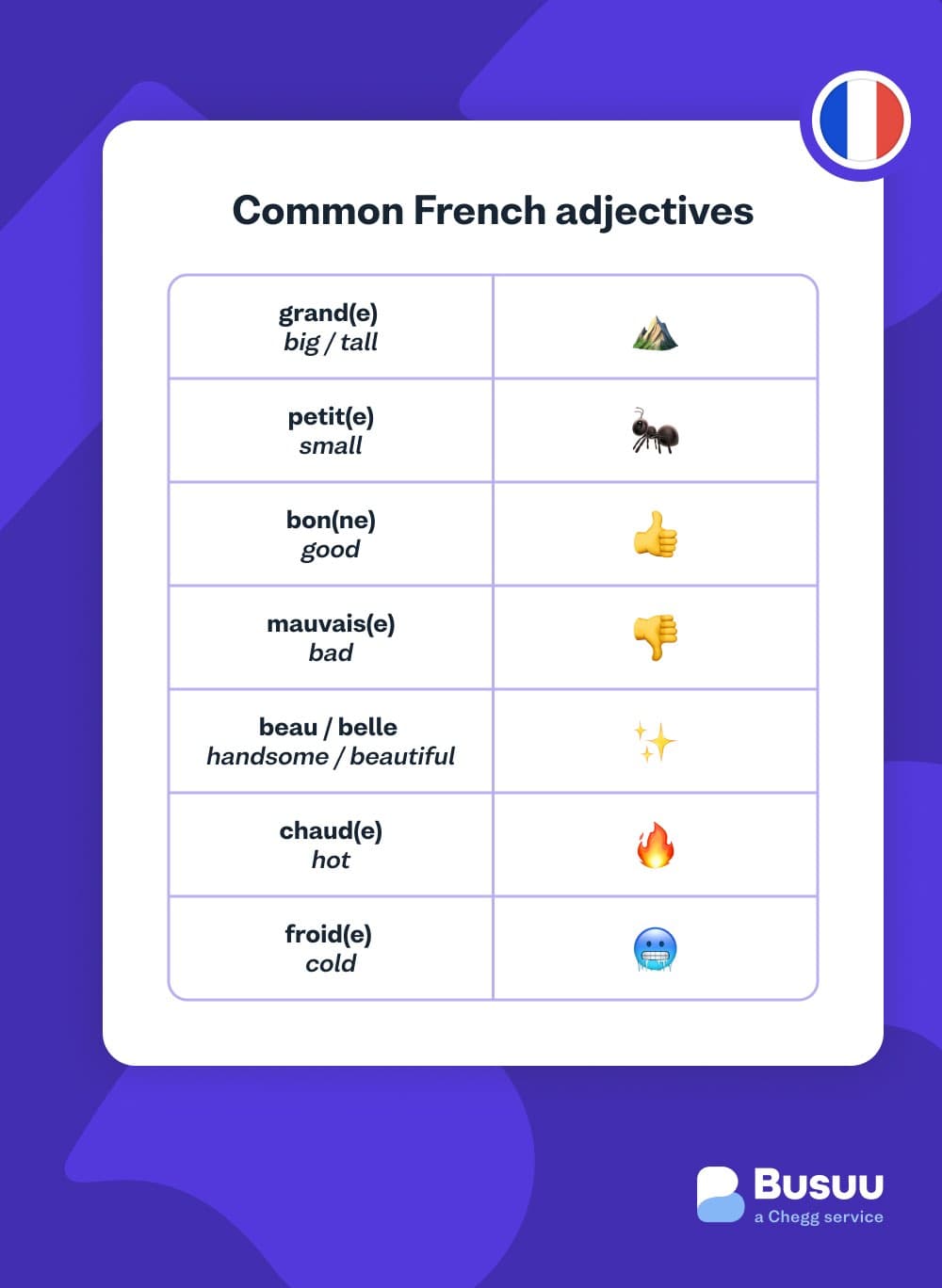
Here it is important to note, that if a masculine noun starts with the letter “h” or a vowel, the masculine adjective beau is spelled bel.
Irregular masculine and feminine adjectives
The only exceptions to the rules above, are irregular adjectives, as you can see with the word beau. The feminine version of the adjective is a completely different word, belle. Below are a few more irregular adjectives to make note of.
Irregular masculine and feminine adjectives with their meanings
| Masculine Singular | Feminine Singular | Meaning |
|---|---|---|
| personnel | personnelle | personnel/staff |
| cher | chère | dear |
| blanc | blanche | white |
| bon | bonne | good |
| nouveau | nouvelle | new |
| heureux | heureuse | happy |
Note: Here it is important to note, that if a masculine noun starts with the letter “h” or a vowel, the masculine adjective nouveau is spelled nouvel.
Exception: Irregular adjectives that do not change according to gender
While most adjectives have masculine and feminine forms, there are also some adjectives that remain the same no matter the gender. Most of them, as you can see, already end with the letter “e”.
Irregular adjectives that do not change gender
| Masculine/Feminine Singular | Meaning |
|---|---|
| calme | calm |
| riche | rich |
| timide | timid |
| rapide | rapid |
| difficile | difficult |
Tip: There are so many French grammar rules to remember! But you probably already know so many French words that are commonly used in English. Read about the 99 French words we use in English all the time.
Plural masculine and feminine adjectives
Going back to the example of masculine and feminine grand and petit, the plural forms of these adjectives simply include adding an “s” at the end of each masculine and feminine forms.
Plural masculine and feminine adjectives
| Masculine Plural | Meaning | Feminine Plural | Meaning |
|---|---|---|---|
| des hommes grands des grands hommes | some/a few tall men some/a few great men | des belles femmes | some/ a few beautiful women |
| des petit chiens | some/a few small dogs | des petites chiennes | some/a few small dogs |
Irregular plural adjectives
Just like with the irregular masculine and feminine forms of adjectives, the plural forms also have different rules. The rule is not to just add an “s” at the end of the word, but often, several letters may be added.
Irregular plural adjectives
| Masculine Plural | Feminine Plural | Meaning |
|---|---|---|
| personnels | personnelles | personnel/staff |
| chers | chères | dear |
| blancs | blanches | white |
| bons | bonnes | good |
| nouveaux | nouvelles | new |
| heureux | heureuses | happy |
Exception: Plural adjectives that do not change according to gender
The adjectives that remain the same no matter the gender also have the same plural masculine and feminine forms. As you can see below, the plural forms of these adjectives simply include the addition of the letters.
Plural adjectives that don't change gender
| Masculine/Feminine Plural | Meaning |
|---|---|
| calmes | calm |
| riches | rich |
| timides | timid |
| rapides | rapid |
| difficiles | difficult |
Possessive adjectives
Possessive adjectives in French or adjectif possessif are used the same way as they are in English. They are used to denote what or whom a noun belongs to.
For example, if you say “my”, and you are female, the possessive adjective you use would be masculine because your brother – the noun in the sentence – is male.
So the sentence in French would be, mon. Here, mon is the first-person singular possessive adjective.
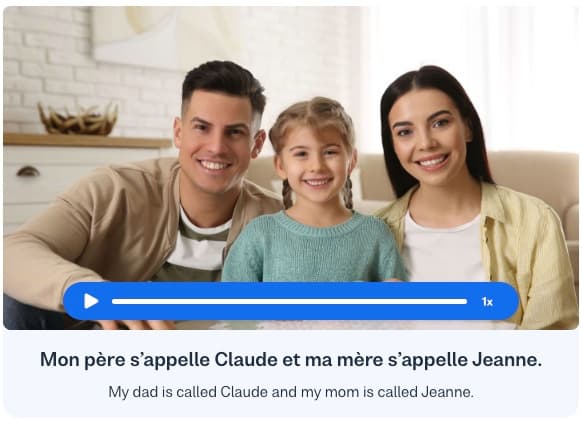
Below is a table of all the French possessive adjectives.
French possessive adjectives
| Masculine singular | Feminine singular | Masculine/Feminine plural | Meaning |
|---|---|---|---|
| mon | ma | mes | my |
| ton | ta | tes | your |
| son | sa | ses | his/her/its/one’s |
| notre | notre | nos | our/ours |
| votre | votre | vos | your/yours |
| leur | leur | leurs | their/theirs |
Exception: Gender
There are only two situations in which gender does not matter when you are using a possessive adjective.
1. Before a noun that starts with a vowel
Just like in English when a word begins with a vowel, you write the word “an” before the word rather than “a”. In French, the possessive adjective also changes according to the first letter of the noun following it.
For example, if you have a female friend, you won’t say ma amie (my friend), you would say mon amie. Similarly, if you want to say “my elephant (female) is big”, you would say mon éléphante est grande.
Before plural nouns
The plural possessive adjectives don’t change according to the gender of the noun.
For example:
mes chats (my cats)
tes chats (your cats)
ses chats (his/her cats)
leurs chats (their cats)
Exception: Body parts
When speaking about body parts, you do not use an adjectif possessif.
For example:
Je me suis cassé la jambe. (I broke my leg)
As you can see, there is no adjectif possessif before the noun. The article la is used instead. This is because the possession is already implied in the word me. This is why the possessive adjective is not repeated before jambe.
Exceptions: Invariable adjectives
One other small group of adjectives exist that do not change according to the quantity or gender. So they are called invariable because they never change no matter what they describe. Typically, these adjectives derive from the name of a fruit, animal, gems, or metal.
For example:
orange (fruit)
café (coffee)
azur (azure)
champagne (champagne)
chocolat (chocolate)
marron (brown/chestnut)
aubergine (eggplant)
rouille (rust-colored)
Having spoken about the above invariable adjective exceptions, it is also important to note that some color adjectives are not exceptions to the rule.
These are as follows:
alezan (chestnut)
fauve (tawny/fawn)
rose (the color pink, flower)
vermeil (vermillion)
Examples using some color adjectives:
Ces boîtes sont marron. (These boxes are brown.)
Elle veut acheter des crayons roses. (She wants to buy pink crayons.)
Il y a des crayons orange dans la boîte. (There are orange crayons in the box)
In addition to the above, there are also other exceptions under invariable adjectives such as ethnicities, and adjectives like demi (half), feu (fire), and nu (naked).
When it comes to adjectives, expanding your vocabulary and the meanings of different words is a great place to start. With the exceptions, they are easiest to remember by committing them to memory.
Newlanguages